Posted in Current Events

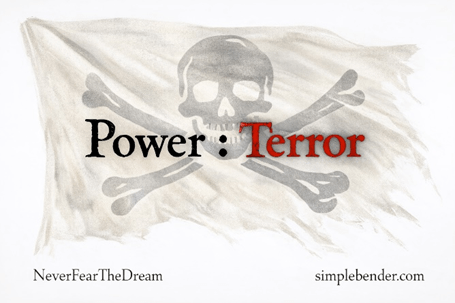
Paradox of Power and Terror

You can’t eliminate terrorist threats by becoming one. You only demonstrate that terror works.

A superpower doesn’t need to win an argument; it only needs to win the moment. And lately, the United States looks less like a restraining force and more like a superpower increasingly willing to use terror’s tools—fear, coercion, and unilateral force—then call the wreckage “security.”

Consider the new precedent we’re showing the world. On the last day of February, U.S. and Israeli strikes on Iran assassinate Iran’s Supreme Leader, Ayatollah Ali Khamenei. This act would have been unthinkable inside the “rules-based order” we demand others respect. When the strongest country on earth normalizes decapitation-by-airstrike, every aspiring strongman learns the lesson: power can replace legitimacy.

Then there’s Venezuela. In early January, U.S. forces invaded and forcefully apprehended President Nicolás Maduro—Washington’s most direct intervention in Latin America in decades. The invasion wasn’t about drugs or oil, but ego. The operation immediately spun the story of necessary law enforcement. But it’s also a template: if we can seize a head of state, others can too.

We used to be the protector of the seas, but now U.S. authorities seize tankers carrying Venezuelan crude and seek forfeiture of millions of barrels, arguing sanctions evasion and links to hostile actors. The message isn’t subtle: “international waters” don’t protect you if you are smaller and weaker, and we decide you’re sanctioned. From protector to pirate.

And coercion isn’t only military. It’s economic. Tariffs, threatened and applied as leverage, even against allies, turn trade into a cudgel. Our regime calls it bargaining, but the targets call it bullying, extortion, and coercion. Either way, it trains the world to treat commerce as warfare by other means.

The contradiction doesn’t stop at the shoreline. When immigration enforcement becomes a national spectacle, dissent gets pulled into the machinery. Amid protests of warrantless immigration detentions, Americans have been imprisoned and killed. Those deaths don’t prove a grand conspiracy; it proves something quieter: when government and protest meet in a fog of fear, people die—and everyone hardens. Terrorism isn’t only foreign. It is domestic, too—not just in bombs, but in the slow conditioning of a public: say less, vote less, protest less, comply more.

If we want the world to reject terror’s logic, we have to stop promoting and exemplifying it. By our actions, we have given Russia moral grounds to press their invasion of Ukraine, and China the justification to embargo and invade Taiwan. What we once did covertly we now do overtly; and shouldn’t be shocked when other countries do the same. We were once admired and known as the protectors of the aggrieved, the helpers of the weak. Now we are the aggressor nation. From savior to storm-trooper. Maybe we should replicate the ‘change’ at home before our national memory forgets the difference between domination and freedom.    NeverFearTheDream   simplebender.com

A nation that uses threats, fear, and terror can never be great; never.

… – .- -. -.. / ..-. — .-. / – .-. ..- – ….


Lap Around the Sun: Daily Steps Forward
by WCBarron

Buy at Amazon Buy at Barnes & Noble Buy at Books2Read

Joy in Alzheimer’s: My Mom’s Brave Walk into Dementia’s Abyss
by WCBarron

Buy at Amazon Buy at Barnes & Noble Buy at Books2Read
Posted in Political

Deconstructing Democracy by Design

A ‘what-if’ thought experiment….or is it….

When federal agencies are defunded, are the states prepared to bear the burden? What if they falter, fail, and unravel under the weight? What if the unraveling of local governance isn’t a consequence of poor planning—but a feature of executive design?

Imagine a government waving the banner of “smaller federalism—drain the swamp,” slashing national programs in the name of efficiency and state empowerment. Medicaid becomes a block grant. Public housing and food subsidies are cut. Regulation and environmental oversight rolls back. Disaster relief is “restructured.” Methodically, the burden shifts to state and county governments, which are already stretched thin. Local taxes rise, services crumble, and local bureaucracies balloon in a vain attempt to compensate.

One town staffs its clinics. The next can’t keep its water clean. Some mandate gun control, others abortions, and others endorse sex work and gambling to increase state revenue. Air quality fluctuates by zip code. One region welcomes immigrants, the next sponsors agents for deportation. Resulting in dysfunctionality, geographical injustice, and discontinuity. The news media is mistrusted and declared ‘enemies of the State’. City, County, and State governments begin to crumble and fail under the weight of their new obligations.

Resentment festers—as inconsistency breeds inequity and confusion. Citizens demand relief, but help doesn’t come from local government, only more indecisive directives. Citizen uncertainty, polarization, and outrage against the policy void yield unrest. Not everywhere—but in enough places to make the headlines—just enough to be used as an excuse.

We’re already seeing a preview. Federal troops were deployed to California—not for disaster relief, but to enforce immigration policy, overriding the state’s will. FEMA faces cuts while climate disasters rise. Communities are left broken, ripe for corruption and manipulation.

And as the ground shifts, so do the guardrails. The Department of Justice leans in, and the Court tilts the scales. Recent rulings—many of which were urged by the Executive—have expanded presidential power by disregarding or reinterpreting laws passed by Congress and previous court decisions. Scholars once warned of an “imperial presidency.” It’s no longer theory—it’s precedent. The President need not wait for Congress. The office can act—or undo—with little more than a pen and a thin legal pretext.

And so, the same hand that dropped the burden returns—not as a partner, but as a “protector.” Protests are reframed as threats. Dissent becomes disorder. Disorder becomes insurrection.

Elections are postponed “for public safety.” Ballots are secured behind walls and counted by select administrators. Local authority is preempted. Emergency declarations morph into permanent policy.

Federal power consolidates—not with a coup, but with a shrug, and tacit approval, marked by deafening silence.

This isn’t prophecy—but it’s no longer just a thought experiment. It is no longer just possible it is verging on probable. It’s unfolding. If federal power can be withdrawn at will and restored at gunpoint—backed by a court with no limits—what does democracy even mean?

If this is the road ahead, it’s not the failure of states we should fear most. It’s the success of the plan—and our failure to notice.