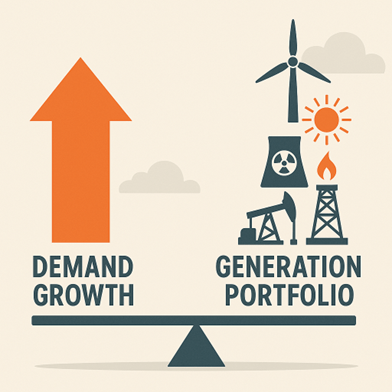
The era of power limitations and rationing may be knocking on our door. Without a portfolio of power generation, the reality of July heat waves and January cold snaps causing rolling blackouts can be expected. Driven by data centers, the focus on household electrification, and a population that expects 24/7 plug-and-play power, the demand for electricity in the U.S. is increasing. Yet, the national discourse is veering towards reducing or even eliminating key alternatives—wind, solar, nuclear—and increasing reliance primarily on a finite resource; hydrocarbons. This is likely a shortsighted policy choice.
It is a potentially dangerous gamble. Our current fleet of natural-gas plants already runs near record levels, and petroleum generation is a rounding error in national totals. The Department of Energy (DOE) warns that by 2030, more than 100 GW of firm capacity will retire, while only 20GW of the planned new capacity is firm, dispatchable power. This type of power, which can be relied upon to meet demand at any time, is crucial for maintaining a stable and reliable grid. Even if we invested in new gas turbines today, it would take years to finance, permit, build, and connect them. Transmission projects face decade-long lead times even with streamlined regulations. In the meantime, demand does not politely wait—it climbs relentlessly, pressing the grid ever closer to its limits and breaking point.
And when, not if, the grid fails, the pain will not be evenly distributed. Households near and below the poverty line will suffer the most. For them, a prolonged outage in the middle of a heat dome or a polar vortex is not just uncomfortable—it is life-threatening. Wealthier households can afford generators, home batteries, or even leave town, but the poor cannot. Businesses will be forced to close, adversely affecting commerce. The cascading effects will stress public safety, and security risks will magnify as communications, traffic systems, and emergency response falter. This isn’t a dystopian forecast but a reasonable scenario to expect, or at least plan for.
The capital cost of replacing all lost alternatives with new gas is daunting, and would expose consumers to fuel price volatility and emissions penalties. More importantly, it overlooks the reliability and diversity that a balanced portfolio brings. A grid built on a single fuel is fragile—one pipeline outage, one price spike, one extended heavy load event away from disaster. Just like your personal finances, a balanced portfolio is more stable and outperforms all others. By diversifying our energy sources, we can build a more resilient and reliable grid, providing all of us with reassurance.
A more prudent path forward is to accelerate what works: finish stalled renewable projects, extend nuclear plant lifetimes, and streamline permitting for clean firm capacity. Oil and gas should remain the dependable floor—the baseload anchor, providing a consistent level of power—but not the sole pillar holding up the house. Meeting demand is possible, but only if we stop dismantling the roof while the storm clouds are gathering. My life has been in the oil and gas industry—but we must recognize that wind farms aren’t inherently evil; solar energy has its place in many regions, nuclear power should always be an option, and battery technology is essential. The choice is between planning now and positioning for the future. Spiking energy costs and rolling blackouts should not be acceptable options; they should be considered national failures. #NeverFearTheDream
Always feel free to re-post—anywhere, anytime, to anyone—share freely.
NeverFearTheDream simplebender.com Stand For Truth
If you’re looking for daily thoughts and insights you will want to start the morning with:

If you know someone who is facing any facet of Alzheimer’s they might gain some insight from:

Please consider following simplebender, you’re reading makes my writing more fun..…
Comments and thoughts are always welcome and feel free to re-post …..
 SimpleBender.....wcb