Posted in Philosophy

Your Step is Your Choice

Where you step matters more than how you step.

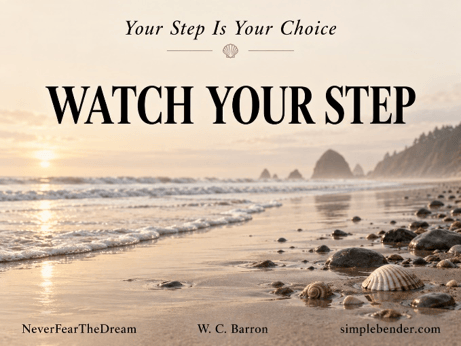
Walking along the rugged Oregon coast at low tide, I found the exposed sand smooth, firm, yet forgiving. I strode briskly, watching the surf and gulls and listening to waves breaking against the distant capes. I slipped off my sandals to feel the cool sand. My pace grew easy and carefree—until I stepped hard on the first stone.

Without noticing, I had wandered from smooth sand into a stretch peppered with stones, broken shells, and the discarded armor of crabs. My stride changed immediately. The beach hadn’t stopped me, nor had my destination changed, but suddenly where I placed my foot mattered more than how gracefully or quickly I walked. The journey remained the same distance. The experience and conditions had changed significantly.

I could have put my sandals back on and barged through. Protection was available to me. But something was interesting about staying barefoot. I had to pay attention. Every step required a small decision: sand, stone, shell, water. Being exposed without protection demanded awareness.

Life often offers us sandals. Money, position, privilege, education, experience, even simple good fortune can insulate us from terrain others must feel directly. There is nothing inherently wrong with wearing sandals. Sometimes wisdom demands them. But protection carries its own danger: eventually we may stop noticing what we are walking across—or what others are walking across without them.

That led me to another question. How much of our path do we actually choose? Some of it, certainly. Decisions accumulate beneath us like footprints in wet sand. But none of us selects the entire terrain. We inherit circumstances, encounter unexpected stones, climb hills we never intended to, and sometimes find ourselves on roads we would never have chosen. We may not be responsible for every path beneath our feet, but we remain solely responsible for the next step and its consequence.

Perhaps that is one of life’s quieter distinctions. The path is shaped by circumstance. The step is a choice. And the things we place between ourselves and the ground are protection. Wisdom lies in knowing which is which.

Life’s road is rarely narrow, straight, or smooth. It twists through roots and rocks, rises unexpectedly, and occasionally opens onto stretches of wonderfully firm sand. Sometimes we walk beside others; sometimes the path narrows, and we walk alone. Either way, attention matters. We should notice the hazards and opportunities along our path, but also recognize that the person beside us may be walking barefoot on entirely different ground.

Walk quickly if you wish. Walk slowly if you need to. Wear sandals when the terrain demands them, and take them off occasionally so you remember how the ground feels.

Watch where you step; your next one might land on someone else.

NeverFearTheDream………. W. C. Barron………. simplebender.com……….keystonecompact.org

-.– — ..- .-. / … – . .–. / -.– — ..- .-. / -.-. …. — .. -.-. .


Lap Around the Sun: Daily Steps Forward
by WCBarron

Buy at Amazon Buy at Barnes & Noble Buy at Books2Read

Joy in Alzheimer’s: My Mom’s Brave Walk into Dementia’s Abyss
by WCBarron

Buy at Amazon Buy at Barnes & Noble Buy at Books2Read
Posted in Keystone

Personal Liberty Is the Default

In a free country, the government should need a reason to interfere. Citizens should not need a permission slip to live peacefully.

If rights are universal rather than political trophies, government cannot assume that citizens must justify their private lives. The burden must lie the other way.

In a free country, the government should need a reason to interfere. Citizens should not need authorization or permission to live peacefully.

That proposition sounds almost too obvious to debate. Yet governments have a recurring temptation to become a life manager. It goes beyond preventing harm and begins to police identity, sexuality, books, faith, speech, conscience, association, medical choices, and private conduct. The justifications vary. Sometimes control is sold as morality. Other times, it is sold as safety, fairness, inclusion, public health, or social progress. The label changes; the presumption of authority remains.

The Keystone Compact has a simple rule: a peaceful adult life belongs to the person living it; first and foremost.

Adults should be free to worship or not, marry, speak, associate, raise families, pursue work, make personal medical decisions, and live according to their conscience, as long as they do not violate others’ rights, safety, or property. Difference is not evidence of danger. Disapproval is not proof of harm. Offense is not coercion.

That final boundary matters because liberty is not license. Freedom is NEVER an excuse for violence, theft, fraud, abuse, exploitation, neglect, coercion, or public danger. A person cannot claim liberty as a shield to harm another. Government has a legitimate and necessary role when force is used, contracts are broken, children are endangered, property is taken, public order collapses, or one person’s conduct destroys another’s equal freedom.

The principle is maximum practical liberty and minimum necessary force. Neither half can be discarded.

Liberty without responsibility is raw selfishness. Responsibility without liberty becomes control. A mature public philosophy must resist both errors. Modern tribal politics rarely does. Populists often want government weak when regulating business or setting taxes, then suddenly powerful enough to punish cultural enemies, restrict intimate choices, or enforce a preferred moral order. Progressives often celebrate personal autonomy, then build administrative systems broad enough to regulate speech, compel language, manage risk, and engineer social outcomes. Each side recognizes the danger of power and becomes remarkably imaginative about its uses when in control.

The Keystone standard is not about whose values prevail. It is about whether strong-arming is necessary to protect another person’s rights.

Let’s consider ordinary life rather than ideological abstractions. A neighbor worships differently. An adult child chooses a life a parent never imagined. A family faces a complex medical decision. A worker wants to do the job without turning every workplace conversation into a political loyalty test. A bookstore carries material some residents dislike. A peaceful citizen owns a firearm, attends a protest, declines to attend one, raises children in a faith, or raises them outside one.

A free society does not require approval for these choices. It requires enough humility to distinguish personal disagreement from public harm. That distinction protects conservatives as much as liberals, religious citizens as much as secular ones, and majorities as much as minorities. Once government is authorized to regulate peaceful identity or conscience, no group can be certain it will remain the favored one. The rules crafted to discipline today’s opponent become tomorrow’s inheritance.

Personal liberty mandates civic obligation. Free people must tolerate frustration from one another. They must learn to persuade rather than compel, to live alongside differences they cannot reconcile, and to reserve the law for conduct that genuinely causes harm. Self-government is not the absence of moral judgment. It is the refusal to make every moral judgment a matter for the police.

The government should protect citizens from harm, not manage their private conscience.

So when did peaceful disagreement become a government problem? Usually, it happened when a political faction realized that persuasion and compromise were harder than wielding power.

If liberty is the default, government must know what it is for and what it is not for. That is the final foundational brick before the Keystone Compact turns to budgets, institutions, and policy.

Next in Category I: Government Should Know Its Job – and Its Limits

Posted in NeverFeartheDream

Never Fear The Dream…

Nothing in your life is pre-determined, not your personality, disposition, intelligence, physical prowess—nothing. You shape your destiny through the simple, every day, mundane choices you make. 26.06.09

…. ..- — .- -. / … .–. .. .-. .. – / .– .. -. …

Posted in Philosophy

Choice, Chance, Change

It’s easy to fall into a routine—a pattern, a path, a simple rut. After a while, it can feel like being a snake in a wagon-track after rain: pressed into the groove, unable to see a clean way out. Stuck. Destined to follow the track wherever it leads.

But remember, you helped get yourself into it, and you can help get yourself out. The way out begins with choice, then a chance, then change. Even when a situation feels unsolvable or risky, you can still act—if only to begin the process. Yes, many parts of life are socially or professionally controlled. Even inside those boundaries, there are choices—subtle ones, small ones, but choices, nonetheless. The point is to exercise them.

Every choice has consequences. That is not a reason to freeze; it is a reason to brace. The choices and chances do not have to be big, bodacious gestures. Small, incremental shifts can be deeply significant. Change often starts there: deciding you want it, choosing toward it, and accepting the chance that comes with each step.

You don’t have to wait for a grand opening, a sign, or even the perfect plan. You need to make a choice and follow through — today. Even a small pivot can change your life’s course. Many of us like the phrase  ‘turning over a new leaf’ because it is clean and peaceful. In practice, it is usually more complicated than the phrase suggests—longer-term, sometimes riskier. Still, the principle holds: be willing to turn the leaf and look for something new. Yes, there may be thorns. That comes with reaching. Sometimes the only way to discover is to try.

And if you think you’ve already turned every leaf in your effort to change, wait for spring. There will be a whole forest again—even the trees in your own yard will leaf out—offering a fresh crop of leaves to turn; nature is annoyingly generous that way. Take a deep breath and just start turning.  NeverFearTheDream     simplebender.com

– ..- .-. -. / – …. . / -.. .- — -. / .-.. . .- ..-.


Lap Around the Sun: Daily Steps Forward
by WCBarron

Buy at Amazon Buy at Barnes & Noble Buy at Books2Read

Joy in Alzheimer’s: My Mom’s Brave Walk into Dementia’s Abyss
by WCBarron

Buy at Amazon Buy at Barnes & Noble Buy at Books2Read

Posted in Current Events

The Logic Trap of “Choice”: But Whose Choice?

Some communities insist no one has the right to tell you what goes into your body. Vaccine mandates for children? Eliminated. Parents, they say, should decide. Yet the same lawmakers ban abortion, declaring the state must dictate what goes into—or comes out of—a woman’s body. One breath they champion autonomy—“your body, your choice.” The next, they revoke it. That is the hypocrisy of their own making: a logic trap.

This is hubris—elevating choice above consequence until the reckoning arrives. By enthroning autonomy in one case and crushing it in another, political positions collapse under their own contradictions.

The deeper problem is not hypocrisy alone, but the refusal to face consequences. If a sick, unvaccinated child infects another and death follows, is that so different from a parent choosing to end a pregnancy? Both are questions of prevention—or its absence. Both end in the loss of life. Stripped of rhetoric, the moral arithmetic is the same.

Plato’s Ship of State reminds us that freedom without shared responsibility is not freedom but chaos. To let each untrained helmsman steer as he pleases is to wreck the vessel and drown all aboard. Vaccine “freedom” follows the same course: individual choice unmoored from collective duty imperils the innocent.

Abortion bans claim to “protect life.” Yet removing vaccine safeguards erodes the very protections that preserve the living. Both paths, meant to uphold life, may instead hasten its loss. Vaccination is not solely a personal decision; it is an act of care for the vulnerable child who cannot choose. To shrug it off is to clearly echo and exclaim the denial: “I am not my brother’s keeper.” That is tragedy—outcome born of blindness to consequence.

If morality is to mean anything, it cannot be applied with one hand and denied with the other. If a child who is unable to be vaccinated dies from exposure, who bears responsibility? The parents of the unvaccinated infecting child? The government that stripped safeguards? The community that endorsed it? Those who hold women accountable for abortion, especially those who are rape victims, cannot escape this parallel dilemma. Freedom framed as virtue but practiced as refusal to protect another is no virtue at all. Either the body is inviolable, or it is not. Either life is sacred in all forms, or it is not. Pretending otherwise is meant to satisfy a political base, but it cannot withstand the test of reason—or history. #NeverFearTheDream

For Every Problem...A Solution...
Lap Around the Sun: Daily Steps Forward
Joy in Alzheimer’s: My Mom’s Brave Walk into Dementia’s Abyss