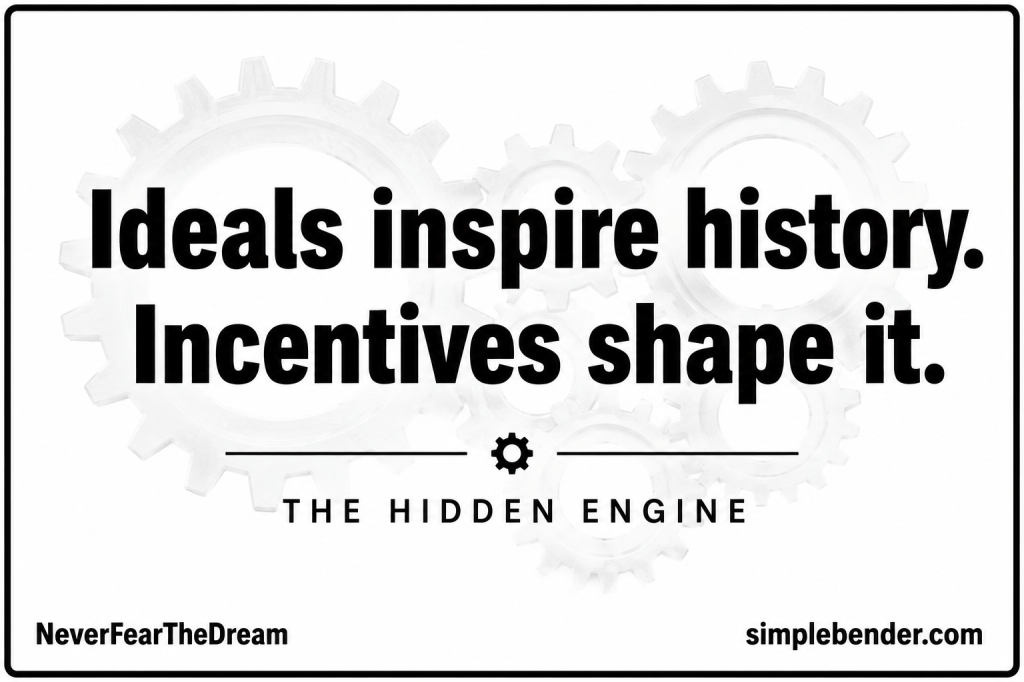
History can be viewed through many lenses—culture, religion, technology, personalities, and ideals. One of the least celebrated, yet most consistently revealing, is incentives.
Our nation’s history, like that of most nations, is wrapped in slogans, banners, symbolism, and stirring ideals. Those are the stories we are taught, love to recite, and eagerly pass down from one generation to the next. Beneath them, however, lies a quieter force: incentives. History is also a story of wealth, resources, and the struggle to control them. Looking beyond the slogans does not diminish our past—it helps explain it, understand our present, and better anticipate our future.
History loves heroes because they are easy to remember. Incentives are harder to celebrate, yet they often explain why events unfolded as they did. The American Revolution is remembered as a triumph of liberty over tyranny. It was also a dispute over taxation, restrictions on western land, merchant profits, and who would control the colonies’ economic future. Liberty became the language of the revolution; incentives supplied its momentum.
The Constitution is rightly celebrated as the foundation of our republic. It also sought to stabilize commerce, resolve debt, protect contracts and property, and balance the competing interests of sovereign states and the new federal government. The Louisiana Purchase was as much about controlling the Mississippi River and expanding agriculture as it was about national destiny. The Mexican-American War brought territory, ports, mineral wealth, and farmland, accelerating American growth.
The Civil War is too often reduced to a choice between slavery and freedom. It was also a massive collision between competing economic systems. The North relied on industry, wage labor, railroads, finance, and expanding domestic markets. The South depended on plantation agriculture built on the horrific institution of slavery—a labor system that required enormous capital and drove global cotton production. Tariffs, transportation, banking, and western expansion were all gears in that engine.
The United States entered both world wars only after concluding that its secure commerce and long-term strategic interests were directly threatened, not for the grandiose, much-heralded altruistic reason of ‘saving the world.’ The New Deal helped struggling Americans and stabilized capitalism during an unprecedented economic crisis, thereby averting an outright civil revolt. The Cold War, Vietnam, and the Gulf conflicts were framed in ideological and moral language and falsely cast as pitched battles against Communism and Islam. Yet strategic resources, trade routes, and regional influence consistently drove policy.
The pattern persists today. Taxes, tariffs, national debt, healthcare, housing, climate policy, artificial intelligence, and immigration are debates over incentives and resource allocation. Politics is the mechanism by which societies decide how wealth, opportunity, and resources are created, distributed, protected, and transferred. Major conflicts arise when people no longer agree on those rules.
Every political philosophy ultimately answers one unavoidable question: Who controls the incentives that determine wealth, opportunity, and power? Everything else is the language used to justify those decisions. People rarely fight over money itself; they fight over the rules that determine who earns, keeps, taxes, inherits, spends, or controls it. Look beyond the banners and speeches. Whether the issues are local, regional, domestic, or international, follow the incentives. They have explained our past—and they will be the hidden engine driving our future. NeverFearTheDream simplebender.com
.. -. -.-. . -. – .. …- . … / -. — – / .. -.. . .- .-.. …
-. — / ..-. . .- .-. / -. — / … .. .-.. . -. -.-. .
NeverFearTheDream simplebender.com Stand For Truth
Please consider following simplebender, you’re reading makes my writing more fun..…
Comments and thoughts are always welcome and feel free to re-post …..




 SimpleBender.....W. C. Barron