Posted in Political

No Clear Path

What if you followed the rules? What if you left your family, risked everything on a dream, studied, worked, invested, and built a life around a single opportunity? What if, after doing everything asked of you, you discovered there was no clear path to citizenship? Worse, what if the permission that allowed you to build that life could change at the whim of an executive?

That is part of America’s immigration problem we rarely discuss. We talk about immigrants as though they were a single legal class. They are not.

Some entered the country unlawfully. Some entered legally and overstayed. Others came legally as students, researchers, workers, investors, refugees, asylum seekers, or under humanitarian protections. Their legal status—and their paths forward—are very different.

Refugees and people granted asylum can, currently, pursue permanent residence and, ultimately, citizenship. Qualifying Special Immigrant Visa recipients, including some Afghans who worked alongside the United States, can enter as lawful permanent residents.

But many other legal classifications offer no direct path. Students on F-1 or M-1 visas, exchange visitors on J-1, visitors on B-1/B-2, and treaty traders and investors on E-1/E-2 are here under temporary, nonimmigrant classifications. They may eventually qualify for permanent residence through other means, but their original status does not lead there.

Then there are Temporary Protected Status, DACA, and humanitarian parole. These can allow people to remain, work, study, raise families, and build lives here without providing a direct path to citizenship. TPS is temporary by statute. DACA is deferred enforcement, not lawful immigration status. Parole is temporary permission, not permanent admission.

That distinction matters because temporary protections can expire, be narrowed, terminated, or become entangled in litigation. Someone can follow the rules governing a program and still discover that the protection surrounding them has changed.

Following the rules should mean something.

We are equally careless when discussing immigration violations. Unlawful presence (i.e., overstaying a student visa) is generally a civil violation. Improperly entering the country is different. Under 8 U.S.C. §1325, a first improper entry is generally a misdemeanor. A subsequent improper-entry conviction can be a felony, and reentry after formal removal is a separate felony-level offense.

Those distinctions matter when deciding punishment, but they conveniently disappear when everyone becomes simply an ‘illegal’.

People accused of serious crimes should be arrested and stand trial. If convicted, they should be punished. Immigration status should not immunize anyone from accountability, but it shouldn’t be its sole basis of investigation and prosecution.

Accountability should remain tied to conduct, evidence, and due process. ICE/DHS data illustrate the distinction. An analysis of 438,537 people detained during the first fourteen months of the current administration found that about 3% had convictions for violent felonies such as homicide, sexual assault, or robbery. That does not mean the remaining 97% were all legally present or had no criminal history. It does mean that deportable and violent criminal are very different classifications. Arrests should be honest and focused, not just about meeting a quota.

When deportation is followed by confinement in a foreign prison, another question arises. That confinement is not merely the six-month §1325 penalty being served overseas. Removal, criminal punishment, and foreign imprisonment are distinct legal acts that require separate justification.

America benefits from immigrant labor in agriculture, construction, hospitality, and manufacturing; from foreign students and researchers in our universities and laboratories; and from entrepreneurs willing to invest their capital and ambition here.

We can enforce our borders without pretending everyone arrived the same way. We can remove dangerous criminals without treating every immigration violation as a violent crime. And we can insist on an orderly immigration system while acknowledging that the system itself is often anything but orderly, but it doesn’t have to be violent.

The question we should be asking: If someone follows the rules, shouldn’t there be a predictable rule for what comes next? If we choose not to offer a path, shouldn’t we say so clearly? And when the government changes the rules beneath someone who followed them, how much notice, proportionality, and due process does justice require?

A nation of laws should be strong enough to enforce them—and disciplined enough to distinguish between breaking the law and having the law change under your feet.

NeverFearTheDream   W. C. Barron   simplebender.com

..-. — .-.. .-.. — .– / – …. . / .-. ..- .-.. . …


Lap Around the Sun: Daily Steps Forward
by WCBarron

Buy at Amazon Buy at Barnes & Noble Buy at Books2Read

Joy in Alzheimer’s: My Mom’s Brave Walk into Dementia’s Abyss
by WCBarron

Buy at Amazon Buy at Barnes & Noble Buy at Books2Read
Posted in Favoites

Accountability Gunned Down

and Credibility Mortally Wounded…..

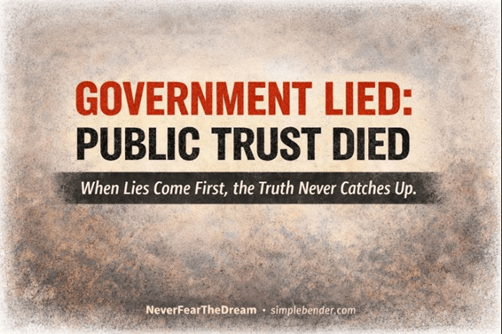
The first videos weren’t clear. They were chaotic—grainy clips, partial frames, shouting without context. But the official messaging arrived before evidence was gathered, witnesses interviewed, or a timeline stitched together, the verdict was delivered. Heroic officers. Clear self-defense. Thwarted mass terror. The dead were “deranged domestic terrorists,” and the valiant officers had barely survived and saved many.

That’s narrative warfare—not investigation.

This is the modern media playbook: speak first, speak loudly, and force everyone else to prove you wrong. Flood the zone with ‘certainty,’ half-facts, and righteous adjectives. Let supporters do the rest. If later evidence complicates the story, it won’t matter; the first impression has already been welded into identity. And if you can manufacture images, clips, or “context” with AI, you can make doubt look like proof while you stall, bury, and obscure the real record.

What makes the lie persuasive is that it rides on a few fragments of truth. A legal concealed-carry permit becomes a justification for killing. A photo of a holstered firearm becomes “brandishing.” A moment of chaos becomes “attempted assassination.” A tender snapshot of agents “helping” a frightened child becomes moral cover for whatever came before or happens after. The lifestyle of one is used to instill moral judgment and question motive. Just enough ‘truth’ to make the rest feel plausible to the true believers.

We’re told to relax. Trust the regime and its process. Wait for the facts they want to show us. The rest of the facts arrive late and edited—while the narrative sprints ahead, unchallenged and amplified by officials who treat accountability as optional.

There’s a deeper fatal wound: credibility. Bullets may have killed Renee Good and Alex Pretti, but the words that followed targeted something larger—the public’s ability to discern what is real. When institutions train citizens to doubt their eyes and distrust every correction as “spin,” they aren’t governing; they’re conditioning. They are self-serving protectionists maximizing propaganda’s bullhorn.

So we should ask, without hysteria or naiveté: Was a five-year-old used as bait or as a shield? Was Good’s death justified or convenient? Was Pretti killed because he believed in the 2nd Amendment or because zealous masked bullies lost control of themselves? If we can be pushed to accept a finished story before an investigation even begins, what else have we been trained to swallow—about elections, wars, enemies, or the files that power keeps sealed? Move along, citizen. Nothing to see here.   NeverFeartheDream   simplebender.com

Joy in Alzheimer’s
W.C. Barron
Lap Around the Sun
Daily Steps Forward — W.C. Barron
Posted in Current Events

Operation Wetback 2.0: America’s Immigration Purgatory

(Except for First Nations….Lest we forgot, we are all immigrants, lest we forget.)

America’s immigration history has two defining bookends—both failures that masquerade as solutions: brute force and endless procedure. In the 1950s, the United States chose force—regionally and aggressively. Today, it chooses process—nationally, diffusely, and with targeted intensity. Both claim legitimacy. Both avoid responsibility. Both are unapologetic for failure and death. Neither deserves moral cover; both merit condemnation.

In the late 1950s, Operation Wetback was panic impersonating as policy. It treated human beings as a problem, refuse, to be flushed from the system—quickly, cruelly, and visibly. Across the Southwestern United States, Texas, California, Arizona, and New Mexico became enforcement zones. Farms, towns, and cities were swept with little regard for documentation or citizenship. The only thing that mattered was ethnicity. Its defenders praised its “effectiveness,” even calling it “a model,” collapsing ethnics into numbers. Humans were caged. Deportations were swift. Fear spread quickly—along with the erosion of constitutional restraint and human dignity. Citizens were caught up. Families were broken. People died.

For all its cruelty, Operation Wetback held one principle firm: deportation meant returning people to their country of origin, typically Mexico. Removal was brutal, but the destination was at least coherent. The state expelled people to a homeland, not into geopolitical limbo.

Condemning that era is easy. The more demanding task is confronting the present.

Today’s ICE-DHS enforcement regime operates as a nationwide system, shaped by discretion, delay, and unequal impact. Enforcement now extends coast to coast, embedded in courts, databases, detention centers, and subcontracted detention abroad. Deportation no longer guarantees return ‘home.’ Individuals may be transferred to third countries not because of their origin but because corrupt, weak governments are willing to accept detainees in exchange for compensation or a diplomatic concession—transactional detention, prisons for hire.

There are hearings now, maybe. Appeals, maybe. Paperwork, surely. Shockingly, today’s violence is less and more isolated, but still vile, unnecessary, and with bystanders being provoked and killed. Actions outsourced to undertrained enforcement at the direction of uninformed and opportunistic bureaucracy. Masked agents, hide their faces, names, and affiliation, are brandishing weapons and using unwarranted force without accountability. Families are not always torn apart in a single raid; instead, more perversely, they unravel over months or years of detention, uncertainty, and displacement.

Operation Wetback was cruelty without due process. Today’s enforcement is often one-size-fits-all, due process without courage. One system expelled people brutally but directly. The other disperses suffering nationally and indefinitely. America’s most infamous mass deportation campaign reveals a shift not from cruelty to compassion, but from visible brutality to managed, indefinite human limbo and indifference.

Immigration laws should be followed by everyone and every organization. We need immigration control and enforcement, but not draconian brutalization. The tragedy is not that America once chose force. It is that, decades later, it still refuses to choose honesty. This is the immigration purgatory we now live in and may die in.   NeverFearTheDream · simplebender.com

Joy in Alzheimer’s
W.C. Barron
Lap Around the Sun
Daily Steps Forward — W.C. Barron
Posted in Current Events, Political

Protection of Dissent

Decent people support dissent   NeverFearTheDream  simplebender.com

Democracies don’t die when people stop agreeing; they die when people stop dissenting. The loud, awkward, sometimes offensive voices are not a nuisance in a free society—they’re proof the system is still breathing.

We like to think “decency” means keeping things calm and polite. But genuine decency involves the courage to say, “This is wrong,” when power would rather you stay silent. The “decent” citizen who never questions authority isn’t truly decent; they’re just obedient.

That’s why dissent is always the first target of any controlling system. Not murderers. Not fraudsters. Not the genuinely dangerous. No, the temptation is to start with the inconvenient. Today, that often means immigrants, students, and visa holders. ICE and DHS don’t just police borders; they’re increasingly policing opinions—trawling social media, flagging protest, and turning lawful speech into a quiet risk factor for deportation.

On paper, the First Amendment belongs to “the people,” not just citizens. In practice, the easiest place to test new forms of control is with those who have the weakest political footing. If you can punish an international student for a tweet, you’ve just built a working model of speech control that can be scaled later. The laboratory is immigration; the product can be rolled out to everyone else.

That’s where the “protection of dissent” comes in. If decent people, like us, sit this out because they dislike the protesters’ slogans or hashtags, they’re missing the plot. The issue isn’t whether we agree with the content of dissent. The issue is whether the government can quietly attach a price and a punishment to dissent, leaving only the reckless or the desperate willing to speak.

History is blunt: once it becomes dangerous to disagree, it eventually becomes dangerous to be different.

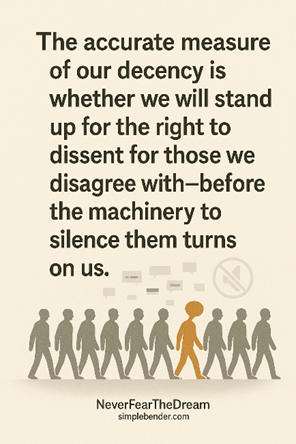
The accurate measure of our decency is whether we will stand up for the right to dissent for those we disagree with, before the machinery to silence them turns on us. NeverFearTheDream   simplebender.com

Joy in Alzheimer’s
W.C. Barron
Lap Around the Sun
Daily Steps Forward — W.C. Barron