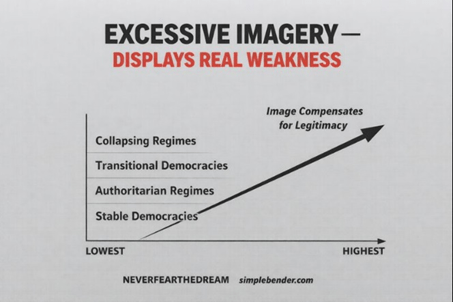
When I worked in Syria, Assad’s pictures and banners were everywhere. There was a saying you heard quietly uttered and trusted immediately: You can tell the weakness of a leader by the number of his portraits hanging in public. It wasn’t cynical. It was observational. People who had lived under strongmen understood; power that must constantly announce itself is power that doubts its own legitimacy.
We once believed America was exempt from this rule. Our institutions were supposed to be independent, strong, equally balanced, and impersonal enough to keep authority both distributed and temporary. That confidence now seems naïve.
Modern American politics is increasingly visual, performative, and personality-driven. Faces dominate screens—names eclipse policies. Rallies resemble revival meetings. Loyalty is measured by personal allegiance rather than by commitment to constitutional principles. Flags, slogans, branded backdrops, portraits draped across government buildings, names adorning every possible grift, and omnipresent imagery—assertions of dominance in a restless, anxious public square.
When institutions lose trust, leaders step forward as symbols, as demigods. When governance grows complex and outcomes disappoint, image fills the void left by results. Legitimacy shifts from systems to the worship of individuals, from rules to personalities. The leader does not serve the institution; the institution is recast to serve the leader.
The more fragile trust becomes—in elections, courts, media, and science—the more faux leaders insist on being ever-present. Every success must bear their name and likeness. Every failure must be blamed on an enemy. Every criticism becomes sabotage and treason. In this environment, real leaders cannot afford to fade into the background of dysfunctional systems, which are themselves under strain.
This transformation is dangerous, not dramatic. Once power is personalized, disagreement becomes disloyalty. Oversight becomes persecution. Independent judges, journalists, and civil servants are no longer neutral actors but obstacles to image maintenance. Reality itself becomes negotiable because the image cannot tolerate correction. Facts that undermine the portrait must be attacked, dismissed, twisted, or replaced.
This is how republics erode without collapsing—slowly, legally, and often enthusiastically. Genuine leadership does not require constant reaffirmation. It does not need its face everywhere or its name in every chant. It governs through institutions robust enough to outlast any individual. It allows space for criticism because it is anchored in systems, not in the self. Weak leadership crowds out that space. It fills every silence. It demands recognition not because it has earned it, but because it fears what happens without it.
The sage wisdom still holds. You just have to know where to look. The walls are no longer plaster or stone. They are timelines, feeds, stages, and screens. Yet they tell the same story they always have—about insecurity masquerading as strength and the stark divide between leaders who trust and support institutions and those who need to be seen leading. The irony is that every image becomes an incendiary insult, inflaming resistance more than rallying support.
Once you recognize the pattern, the noise becomes legible. And once it is legible, it becomes impossible to ignore. Indeed, You can tell the weakness of a leader by the number of his portraits hanging in public; and history has a way of knowing which effigies to hang-up. NeverFearTheDream simplebender.com
-. — / ..-. . .- .-. / -. — / … .. .-.. . -. -.-. .
NeverFearTheDream simplebender.com Stand For Truth
Please consider following simplebender, you’re reading makes my writing more fun..…
Comments and thoughts are always welcome and feel free to re-post …..