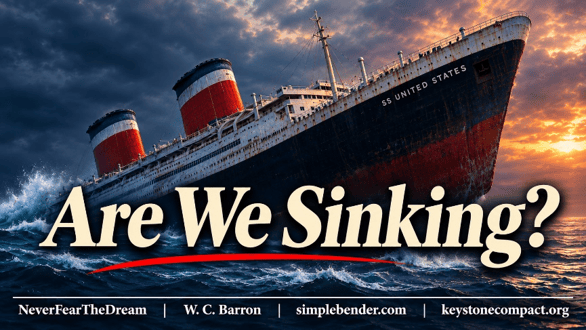
In 1952, the SS United States crossed the Atlantic faster than any ocean liner before her. She was an engineering marvel and a symbol of a nation’s ingenuity, industrial strength, and confidence. Built during an era when America believed its greatest achievements lay ahead, she represented more than speed. She embodied a country leading the world. Now, more than seven decades later, she is a rusting, derelict shell, scuttled off the Florida coast and now serving as an artificial reef. Once a monument to greatness, resting on the ocean floor.
Like her namesake, the United States emerged from World War II with extraordinary power and international prestige. American leadership helped rebuild Europe, establish international institutions, and promote a rules-based order meant to prevent conquest from becoming an acceptable instrument of national ambition. We were hardly innocent in applying those principles, yet our influence rested on something greater than military superiority. The world, however, imperfectly, believed that America stood for something beyond itself.
Today, that confidence has eroded and our image tarnished. We condemn territorial aggression while softening our treatment of Russia, whose invasion of Ukraine violates the sovereignty we claim to defend. We champion human rights while providing diplomatic protection and military support to Israel, despite mounting international criticism of Israel’s genocidal acts in Gaza and the occupied West Bank. Israel has legitimate security concerns, just as Ukraine has an unquestionable right to self-defense. But neither friendship nor strategic convenience should determine whether international principles apply.
The contradiction is not that America maintains different relationships with different countries. Diplomacy demands distinctions. The hypocrisy emerges when the standards themselves appear negotiable, when aggression is unacceptable only when committed by an adversary, and when civilian suffering is tolerable when inflicted by an ally.
America’s competitors understand this vulnerability. They need not defeat our military to weaken our influence. They need only point to the distance between our declarations and our decisions. Every exception offered without a defensible principle becomes another crack in the hull of American credibility.
Yet the SS United States offers another lesson. Her decline was not due to a single catastrophic failure. Aviation reshaped the economics of ocean travel. Maintenance became costly, commercial relevance waned, and preservation grew increasingly difficult. Her extraordinary engineering could not overcome a world that had changed around her.
Perhaps America’s greatest danger is similar: mistaking yesterday’s superiority for tomorrow’s relevance. Military strength, economic scale, and historical achievements remain formidable, but none guarantees international respect. Leadership must continually earn what power alone cannot command: trust.
The ship’s final destination is not entirely tragic. As a reef, she may support new life and serve a useful purpose. But a nation should aspire to something more than becoming a historical monument around which others build their futures.
The SS United States descend beneath the waves because her useful life as an ocean liner has ended. The United States, as a nation, still has the power to shape its uncertain future. It is more than a ship. It is a moral lighthouse whose lamp has dimmed and whose lens has been soiled. But we can recharge it and clean it.
The question is whether we will repair our principles while we still command the bridge, or continue celebrating our past greatness as the water rises?
… .. -. -.- .. -. –. / … …. .. .–.
NeverFearTheDream………. W. C. Barron………. simplebender.com……….keystonecompact.org
-. — / ..-. . .- .-. / -. — / … .. .-.. . -. -.-. .
NeverFearTheDream simplebender.com Stand For Truth
Please consider following simplebender, you’re reading makes my writing more fun..…
Comments and thoughts are always welcome and feel free to re-post …..

