Betrayal should hurt. It should burn a little, especially when it is a betrayal of what we once believed ourselves to be.
Somewhere along the way, we began mistaking the appearance of greatness for greatness itself. We wrapped ourselves in gilded tapestry, built elaborate spectacles, polished the veneer—and hoped no one would notice the tarnish and rust beneath. Our national buildings, institutions, and monuments have been altered, renamed, and draped in political imagery, as their historic meaning increasingly competes with the personality of the moment.
Public money, public space, and presidential attention continue flowing toward spectacle—troops in the capital, cage fights on the White House lawn, the capital’s streets converted for racing, monuments, banners, and ceremonies. The White House increasingly resembles a gilded monument to personal taste rather than the temporary residence of the republic’s leader. Meanwhile, the betrayal: citizens struggle with persistent costs and rising interest rates, the return of preventable diseases, strained global alliances, and global ego-driven conflicts, while families still struggle to build their own small version of the American dream.
Pomp is not power. Pageantry is not leadership. Personal glorification is neither national greatness nor patriotism.
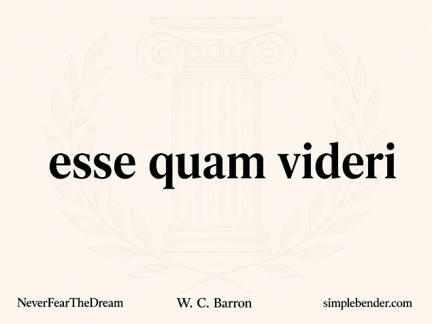
The warning is hardly new. Nearly 2,500 years ago, Aeschylus drew a distinction between being and merely seeming. The Romans later distilled the idea into three enduring words:
Esse quam videri Be rather than appear.
Something feels almost too fitting about confronting a 2,500-year-old warning as America celebrates its 250th anniversary. At ten times the age of our republic, humanity has long understood the temptation—and danger—of confusing appearance with character.
A great nation does not need to continually proclaim its greatness. It demonstrates greatness by what it builds, whom it protects, how it governs, and whether its institutions remain larger than the people who temporarily occupy them.
Ceremony has its place. Nations need symbols, celebrations, monuments, and moments of shared pride. But spectacle becomes dangerous when it stops honoring the country and starts honoring the individual. When institutions become props, public spaces become stages, and governance becomes performance, appearance slowly supplants substance.
Perhaps ‘esse quam videri’ should become more than an old motto—a national reminder and the corrective we need.
We should strive to be the leaders, thinkers, innovators, creators, and builders we claim to be—not merely appear to be them. Bluster is a thin veil, and the world is perfectly capable of seeing through it.
We are better than a gilded façade. It is better to show the scars and the resolve behind them than to cover them with gold leaf and ceremony.
America can still put on an impressive show. The hard question is whether, at 250, we still remember or care about the difference between looking great and being great.
Understand: when you build shrines to your own glory, they share your mortality. When you build them for ideals, they endure as long as someone believes.
NeverFearTheDream W. C. Barron simplebender.com
. … … . / –.- ..- .- — / …- .. -.. . .-. ..
-. — / ..-. . .- .-. / -. — / … .. .-.. . -. -.-. .
NeverFearTheDream simplebender.com Stand For Truth
Please consider following simplebender, you’re reading makes my writing more fun..…
Comments and thoughts are always welcome and feel free to re-post …..

