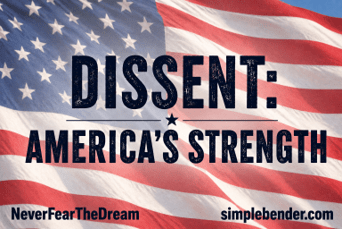
America was never built on agreement. It was built on managing disagreement without abandoning the republic. The great American myth is that we were once united in thought. The great American strength is that we never had to be.
From the beginning, Americans have passionately argued while finding enough common ground to move forward. That is why elections matter. Why opposition is legitimate. Why compromise is a necessity, not a nicety. And why today’s loser must always have the opportunity to become tomorrow’s winner. Violence belongs only as the last resort of last resorts—not the default response.
The Revolution was far from unanimous. Nearly one-fifth of colonists remained loyal to the Crown, while many others chose neutrality rather than rebellion. America did not begin with uniformity of opinion. It began with free people drawing different conclusions about the same future.
The Constitution was not born of unity. It was born of an argument. At the Constitutional Convention, Federalists and Anti-Federalists fiercely debated the proper role of government, individual liberty, and the distribution of power. People of different faiths, economic interests, regions, and priorities concluded that compromise was preferable to division. That wasn’t unanimity; it was constitutional and emotional maturity and a matter of survival.
Dissent has shaped our history. Manifest Destiny divided churches, politicians, and families. The Civil War was the tragic consequence of irreconcilable differences that remain unresolved even today. Americans argued fiercely over entering both World Wars. Reconstruction, civil rights, women’s suffrage, labor rights, women’s rights, immigration, and the role of government all sparked passionate disagreement. Every major turning point in our history has been accompanied by dissent, and its outcome has been shaped by it.
But through this, we have learned not to suppress disagreement but to channel it through the institutions designed for debate and resolution. Unfortunately, today those very institutions are losing their ability to seek compromise. Their representatives protect their own longevity and power and fear their tribe. The value of dissent is being lost for the sake of convenience.
The lesson and goal should never be to eliminate disagreement. Free societies do not survive because everyone agrees. They survive because citizens embrace disagreement as legitimate, necessary, and beneficial.
Today, we still disagree on morality, religion, citizenship, immigration, stewardship, ownership, individual rights and freedoms, and the proper role of government. None of that is new. What is new is the speed with which opinion becomes certainty, certainty becomes outrage, and outrage becomes identity. Immediate communication and unverified information often replace thoughtful research and debate with emotional reaction, making compromise seem like a weakness rather than a sign of wisdom.
The danger is not dissent. The danger is ignorant tribal certainty.
Opposing opinions are rarely obstacles to understanding; they are often its starting point. Every perspective brings experiences we may not have and assumptions we should question. Progress comes not from silencing disagreement but from listening long enough to find where another viewpoint can strengthen our own.
Every generation has believed the nation was coming apart. Yet the republic has endured. And it will unless we fail it. Uniformity has never been America’s way of operating. Dissent, argument, and compromise have been. Our national strength has never been in reaching the same conclusion. It has been in believing that those who reached different conclusions still belong to the same country under the same Constitution.
We see and hear the myth of discord’s devastation, but not the reality of its value. There is power and insight in opposing opinions. There is even greater power in understanding those differences and building on their strengths rather than attacking their weaknesses. Our greatest challenge is not learning to agree, but remembering that the freedom to disagree has always been one of America’s defining strengths. NeverFearTheDream simplebender.com
-.. .. … … . -. – / .. … / … – .-. . -. –. – ….
-. — / ..-. . .- .-. / -. — / … .. .-.. . -. -.-. .
NeverFearTheDream simplebender.com Stand For Truth
Please consider following simplebender, you’re reading makes my writing more fun..…
Comments and thoughts are always welcome and feel free to re-post …..



 SimpleBender.....W. C. Barron