Posted in Current Events

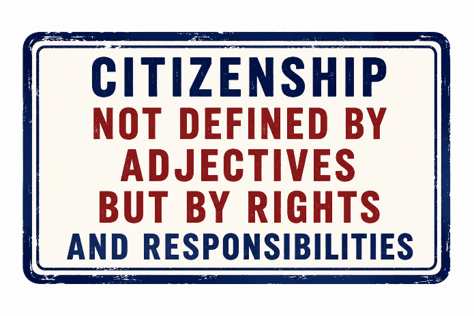
Citizen: Adjectives Not Required

Protection Imperative

America’s founding documents largely avoided attaching adjectives to the concept of “Citizen.” They established broad philosophical principles centered on liberty, personal rights, and self-determination without attempting to divide citizenship into preferred categories. For their time, the idea was radical: a nation built more on shared principles than on shared bloodlines.

Our founders were imperfect people, constrained by the limits and prejudices of their era. Yet many of their aspirations remain deeply human and recognizable today. They sought the freedom to shape their own lives, raise their families safely, worship as they chose, speak openly, and pursue opportunity without a domineering central authority. They envisioned a country driven not by inherited class, tribe, bloodline, or title, but by the ambitions and determination of its citizens.

The Constitution and the Bill of Rights speak largely in universal terms: citizens, persons, and the people. The documents themselves are far more neutral than many who later interpreted and enforced them.

The problem has rarely been the principles. It has been people; it is us, the “Citizens.”

Human beings instinctively protect power once they possess it. They create social and political adjectives around the word “Citizen” to determine who fully belongs, who deserves influence, whose rights matter more, and whose freedoms may be limited. Throughout history, those in power have repeatedly narrowed broad constitutional principles through discrimination, exclusion, fear, and tribal identity.

That reality is precisely why federal and state protections became necessary. The Constitution may aspire toward color-blind liberty; the administration of those principles has often fallen short. Courts and lawmakers must continually wrestle with that contradiction while remaining anchored in the original promise of equal citizenship under the law.

The easy path is to turn a blind eye to humankind’s tendencies. The hard path, but the right one, is to address, restrain, and retrain them and to uphold the standards of our original foundations.

Citizenship carries enormous responsibility and accountability. It also carries extraordinary freedom. Both weaken the moment adjectives become more important than the word “Citizen” itself.                     NeverFearTheDream   simplebender.com

… .. — .–. .-.. . / -.-. .. – .. –.. . -.


Lap Around the Sun: Daily Steps Forward
by WCBarron

Buy at Amazon Buy at Barnes & Noble Buy at Books2Read

Joy in Alzheimer’s: My Mom’s Brave Walk into Dementia’s Abyss
by WCBarron

Buy at Amazon Buy at Barnes & Noble Buy at Books2Read
Posted in Philosophy

Destruction of Ambition: A Bridge Too Far

Moral question: Can military force ever be justified solely against hostile ambition?

There are times when hard power is necessary: to stop an imminent attack, destroy a concrete military capability, or prevent a broader war. But that judgment should never be whimsical, political, or emotionally convenient. It should be thoroughly vetted internally and with allies. The strike should be limited, surgical, and tied to a clear military objective. Anything beyond that starts the walk across a dangerous bridge; a bridge too far.

Destroying an adversary’s will, confidence, identity, or ambition has rarely produced the long-term peace that war architects promised. It runs counter to human nature. It fosters generational hatred. It turns punishment into an inheritance. Once force is used against ambition itself, the target is no longer a weapon, a site, an army, or an imminent threat. The target becomes a ghost of an imagined future. The actions begin to resemble domination rather than defense.

History is rife with attempts to crush the human spirit. The result is usually not a surrender of identity but a hardening of it. The body may be confined. Cities may be shattered. Schools, hospitals, homes, and places of worship may be reduced to rubble. Yet ambition and resolve do not die easily under bombardment. Often, they feed on it.

Gaza is a modern warning. Whatever one believes about Israel’s right to self-defense, the destruction of neighboring civilian infrastructure, and civic continuity has moved far beyond ordinary military norms. The international community has implored Israel to cease genocidal acts. Yet the actions haven’t abated; they are more sinister. UN damage assessments describe catastrophic losses across all sectors of civil infrastructure, commerce, and agriculture, resulting in starvation and disease.

Iran raises a related question. The world was boastfully told that its nuclear capabilities had been “obliterated,” yet conflict persists over what Iran may still desire. The justification is offered with a smirk, ‘but they still have ambition.’ If ambition itself becomes the justification for force, there is no limiting principle.

The moral answer is simple: hard power may destroy capability, but it will not defeat ambition. At best, it redirects that desire. At worst, it sanctifies it. The dream of a Palestinian state hasn’t been crushed but has been strengthened, as has the national resolve and commitment in Iran.

The wiser path is harder: use diplomacy, leverage, alliances, incentives, and restraint to make the right things easier and the wrong things harder. You do not bomb ambition out of a people. You either give it a better avenue or you have helped make it immortal.  NeverFearTheDream   simplebender.com

…. ..- — .- -. / … .–. .. .-. .. – / .– .. -. …


Lap Around the Sun: Daily Steps Forward
by WCBarron

Buy at Amazon Buy at Barnes & Noble Buy at Books2Read

Joy in Alzheimer’s: My Mom’s Brave Walk into Dementia’s Abyss
by WCBarron

Buy at Amazon Buy at Barnes & Noble Buy at Books2Read