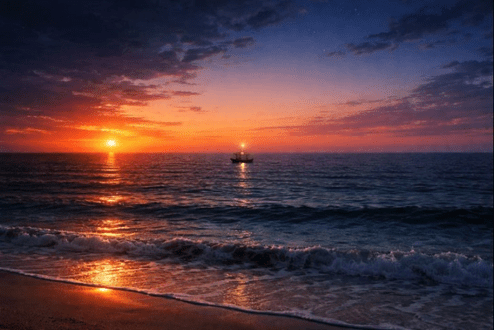
Before dawn, I watched a fishing boat riding the black seam of the horizon off the rugged, unmerciful Oregon coast. The winter swells were building as the storm approached, and one bright mast light—tiny at that distance—kept announcing itself. It bobbed and drifted, sliding right, dipping down, climbing back—never still. The rougher the water became, the more that light danced, hypnotic and uneasy, like a pulse you couldn’t stop watching.
I pictured the crew out there—cold, wet, working for every inch of their livelihood—rocking at the mercy of a winter ocean that doesn’t negotiate. Then the light softened. It blinked once. And then it was gone. Just gone.
I leaned forward and stared until my eyes hurt. Four possibilities flashed through my mind, half of them concerning: the boat had turned, the power had failed, the sea had taken it, or it had sailed over the horizon. When dawn finally thinned the night, I still couldn’t find the vessel. The view was magnificent—and bleakly vacant.
I kept turning it over. That bright beacon was the American Dream: a light you can earn into existence. Risk. Work. Pride in the day’s catch. A stubborn belief that effort matters. It also felt like something else—something more fragile than we like to admit. A vessel doesn’t survive the storm, and its light doesn’t stay bright just because it once was; it stays bright because someone maintains it. Someone powers it. Someone refuses to let it fail.
Now the larger beacon the world has watched—our democracy—looks less steady than it used to. Is the vessel simply turning, its beam shifting out of our line of sight? Or is it losing power? Is it taking on water from neglect, corruption, ego, and self-inflicted damage?
The ocean doesn’t care what flag flies on a boat. It has swallowed the famous and the foolish. What makes this loss feel different is that the light represented not a ship at all—it was a method: an educated citizenry, self-restraint, lawful transfer of power, and the courage to resist tyranny without becoming it. That doesn’t replicate easily. It’s not a gadget you install. It’s seamanship, practiced daily.
Democracy doesn’t need constant tinkering by people trying to remake it in their own image. It needs upkeep. It needs citizens who treat it like a shared vessel, not a private yacht. It needs leaders who care more about the ship and the crew than about the applause on the deck.
I kept scanning the horizon, straining for a pinprick of light—any sign the boat hadn’t gone under. If it’s only turned, the beam will come back. If it’s crippled, we’ll learn what we never wanted to learn: a beacon can fail. If it sailed away, it would be alone in the ocean, and risks increase, especially for mutiny. History doesn’t promise rescue or replacements.
And if we want the beacon back, it won’t be because we wished for it. It will be because we, the crew, set this ship right. Democracies fail the way machines do: ignored tolerances, deferred maintenance, and a crew that doesn’t heed the telltale sounds of failure. So here’s the corrective action: stop rewarding sabotage, stop normalizing lies, stop treating institutions like disposable parts. Do the boring work—vote, show up locally, protect the rulebook, and enforce consequences. If we don’t, the beacon won’t “fade,” but our vessel will lose power and be swallowed by the sea. It will be lost forever. NeverFearTheDream simplebender.com
NeverFearTheDream simplebender.com Stand For Truth
Please consider following simplebender, you’re reading makes my writing more fun..…
Comments and thoughts are always welcome and feel free to re-post …..


 SimpleBender.....W. C. Barron