Posted in Philosophy

Parable: Grandad’s Scales: Honest Measure

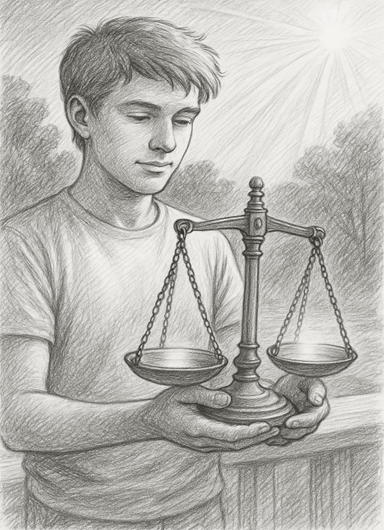
boy holding a balance beam scale to weigh equity not equality

The old man sat on the porch, the autumn wind stirring the fallen leaves. His grandson, an impatient teen, leaned against the rail and sighed heavily.

“Opportunity for everyone—what a joke,” the boy muttered. “Not for us anymore. Maybe for someone else—they’ve taken everything.”

The grandfather didn’t answer. He reached for a small, rusted balance scale on the railing—an heirloom from his own father.

“You know this scale?” he asked. “Your great-grandad was a miner. He used it to weigh ore, but he said it measured something greater than metal—justice. Not everything weighs the same, but a good scale makes sure the measure is fair.”

He dropped a pebble on one pan. “This is what you think you’ve lost.” Then another. “And this, what someone else gained.”

The boy watched, his arms crossed, curiosity overtaking his frustration.

The old man added a third pebble, heavier than the rest. “This one’s the story you were told—that if their side rises, yours must fall. That story was sold by the same people who bent the beam and called it balance.”

The boy frowned. “What do you mean?”

“When I was your age,” said the grandfather, “we believed hard work guaranteed the climb. For a while, it did. Then markets changed and factories closed, machines got smarter, and those who owned the levers of money built taller ladders while the rest of us argued over who deserved the bottom rung. Now they feed you anger because angry men don’t notice the hands at the top pressing on the scale. They treat us like puppets—because too many dance when they pull the strings.”

He flipped the scale over; the pebbles scattered. The arms hung limp, like broken marionettes. “They’ve convinced you the problem is the person climbing beside you. But look closer—the scale isn’t even anchored to the ground anymore. The fight isn’t for equal weight; it’s for honest measure. Equity means measuring every stone’s, every person’s, its true worth.”

The boy’s jaw tightened. “So what do I do with that?”

The grandfather smiled. “Simple. Stop counting other people’s pebbles and start measuring their worth. Fix the scale. Learn, build, vote, speak, stand—not for the side you were born on, but for the fairness your great-grandad believed in. Opportunity isn’t gone, son. It’s just been disguised by those who need you too angry to see the game.”

The boy turned the scale in his hands. It felt lighter than he’d imagined—and suddenly, so did he. He set it on the railing, and as the arms found their balance, the old man said softly, “Remember, life’s not meant to be equal—it’s meant to be just.”#NeverFearTheDream

____________________________________________________________________________________________________________

Author’s Reflection — Equality vs. Equity

Equality assumes sameness, but nature has never been equal. No two stones weigh alike, no two lives start level. Equity is the art of fair measure — adjusting the balance so that justice, not uniformity, prevails. It asks that we see worth in context, not in comparison. The world doesn’t need everyone to carry the same load; it requires each of us to bear our share with integrity and pride. The lesson of the scale is simple: fairness isn’t about equal weight, but about honest measure — the foundation of any just and enduring society.

_____________________________________________________________________________________________________________

Factoids for reference:

  • 54% of Black men born in the bottom income quintile remain there as adults, compared to 22% of White men.1
  • Hispanic children are more likely than Black children but less likely than White children to move up from the bottom 20% into the middle or top 40%.2
  • Black boys earn less than White boys in 99% of U.S. neighborhoods.1
  • Among children from low-income households, only 17% of White children remain in the bottom decile as adults versus 42% of Black children.3
  • Between cohorts born in 1978 and 1992, the racial mobility gap shrank by about 27%, yet Black men and Native Americans remain twice as likely as White men to experience downward mobility.4

1:(Brookings, 2018; Chetty et al., Opportunity Insights, 2018)

2:(Chicago Fed, 2023; Opportunity Insights, 2018)

3:(Equitable Growth, 2022; Pew Research Center, 2022)

4: (Equitable Growth, 2023; U.S. Census Bureau, 2024)

For Every Problem...A Solution...
Lap Around the Sun: Daily Steps Forward
Joy in Alzheimer’s: My Mom’s Brave Walk into Dementia’s Abyss

Posted in Communication

We want to hear what we like to hear…..

cartoon three monkeys one covers eyes, one covers ears and one yells through a mebaphone....

Collectively, we tend to avoid what makes us uncomfortable. We flip past the page, change the channel, swipe away — anything to distract ourselves from what we’d rather not face. We prefer to hear what validates our opinions and makes us feel good about ourselves. More than ever, we seem to believe that something is only valid if it feels agreeable, and we’re becoming openly hostile toward uncomfortable truths.

Some don’t want to hear that being pro-Palestinian doesn’t make someone antisemitic; it may simply mean they are anti-Zionist. Others ignore reports describing an increase in antisemitic violence by domestic white nationalists since the start of the Gaza war and focus more on pro-Palestinian protestors. We may dismiss the idea that small local government is better than big government — especially if we are or were government employees. We might resist the notion that most immigrants pay taxes, work hard to support their families, and deserve due process and a chance at citizenship. At the same time, we might reject the argument that only immigrants who entered legally should have that chance or resist the idea that employers of undocumented immigrants should face prosecution as aggressively as the immigrants themselves.

It makes us uncomfortable to admit that this country has a caste system and remains racially divided, with ongoing systemic discrimination. We may prefer to look away from images of both past and present racism or dismiss the idea of reverse discrimination altogether. Some can study discrimination while others live it; that’s a privilege. Many avoid acknowledging Russia as the aggressor, just as others refuse to confront Israel’s humanitarian atrocities in Gaza. We may ignore the fact that we are a debtor nation — consuming more than we produce, importing more than we export, and holding one of the world’s highest national debts and budget deficits. It’s easier to blame drug trafficking across our borders than to ask why so many of our neighbors are using drugs. We often find it more comfortable to claim victimhood and scapegoat others than to confront the root causes of our problems. We make excuses for those in one group while castigating others on the other side for similar actions.

Through it all, we seek comfort over truth. We isolate ourselves in ideological bubbles, surrounding ourselves with people who echo our views. This mental isolationism is dangerous. Life in an echo chamber is not healthy.

We are eager to listen to what doesn’t offend us — even if it offends someone else. We want to be heard yet often refuse to listen. We can do better. We don’t have to blindly believe anything a charismatic, compelling speaker tells us without analysis. We don’t have to nod our heads just because others do. We are more intelligent and compassionate than we let on. We have more access to information — and misinformation — than any previous generations. We can stop scrolling past the uncomfortable and try to understand. We can try, just a little every day, to listen to something uncomfortable. Listen. We should use every intellectual tool at our disposal to think critically and unpack why it makes us uneasy. We can be as outwardly reflective as we are inwardly introspective. And when we do, the discomfort will feel a little more comfortable.

NeverFearTheDream simplebender.com @simplebender.bsky.social Stand For Truth

This was first published in the Bend Bulletin 4/17/25

Posted in Current Events

Systematic Suppression and Decimation of the LGBTQ Community

Systematic suppression is the intentional and structured ways in which specific marginalized communities are denied rights, opportunities, and resources, leading to their disenfranchisement and inequality with the intent of rendering them non-existent. We have a front-row seat to watch many acts of suppression, from voting rights, immigration, women’s rights, and self-determination. Unconscionable as it might be, we watch acts of suppression accelerate daily. But what is even more concerning is America’s silent crisis—the systematic marginalization and decimation of our LGBTQ community, a pressing issue that demands our immediate and unwavering attention.

You don’t have to engage in direct violence to cause harm to a community. The deliberate restriction of social, legal, and support structures can inflict pain, suffering, and even death to suppress a group. Like enabling discriminatory organizations, you don’t have to be directly involved. Quietly supporting or endorsing legislative intolerance and withholding services can be just as damaging. This community only wants to live with the same protections and rights that all of us should have and expect.

Throughout history, various institutions and organizations have used a cornucopia of justifications to discriminate against minority groups. We are witness to similar patterns in the treatment of the LGBTQ community, where personal beliefs are being used to justify discrimination and denial of fundamental rights.

You may not agree with or approve of the LGBTQ community’s identity or lifestyle. It might even be repulsive, and it’s your right to have those perspectives. But that doesn’t give anyone the authority or right to work toward their marginalization, neglect, and exclusion. There are many more pressing issues to deal with. But, we are easily distracted and misdirected, so we target minorities and create issues where they aren’t. Unfortunately, we are all a part of some minority which might be the next target. You can try to soften it, call it something else, or close your eyes, but there is a fine line between decimation and genocide. This is America’s silent crisis, our silent genocide. It is the systematic suppression of a community within our community, and people are suffering because of it. People’s social structures, personal rights, and medical options are being destroyed and restricted only because some have taken it upon themselves to impose their personal views on others. While currently, the acts of physical violence may be isolated they still exist and are horrible. In addition, people are still being harmed through isolation, discrimination, and denial of fundamental rights. The youth within this community is 4.3 times more likely to attempt suicide than there straight friends. A quarter of this community has tried to kill themselves as compared to 6% of heterosexuals. This group is not just part of our community; they are individuals with hopes, dreams, and rights. These are people and they are being pushed to the brink. These are your neighbors, and amongst many things they are parents, clergy, first responders, care-givers, spiritual leader, legislators, educators, business owners, engineers, artists, authors, farmers, students, industry leaders, and on and on. This group isn’t the enemy. It is an integral thread of our lives tapestry and a critical part of our future. This community should not be silenced or erased, and efforts to do so should not be tolerated or excused. Let people live their lives; maybe everyone will let you live yours with the same dignity and respect.

#NeverFearTheDream simplebender.com @simplebender.bsky.social

This was first published in the Bend Bulletin 3/5/25

Posted in NeverFeartheDream

Never Fear The Dream…

If all you’ve ever known is privilege, you believe in your superiority and resist efforts for equality and balance. If all you’ve ever known is oppression, then you believe in your right to resist. If the privileged sense a loss of inherited rights, they are incensed. If the oppressed gain any new rights, they feel empowered to grasp for more. And so, the power pendulum swings synchronized with misunderstanding and mistrust. At some point, the pendulum must reach a point of stasis, lest we are forever trapped in senseless struggles. 25:07

#NeverFearTheDream simplebender.com @simplebender.bsky.social

Posted in NeverFeartheDream

Never Fear The Dream…..

Hire indiscriminately, promote and terminate on merit; not on project bias. The hardest projects require the best, you reward their effort not the results. Revenge and retribution, like arrogance and pomposity are not leadership skills. 25.051

#NeverFearTheDream simplebender.com

Posted in Political

Beyond Tokenism, Tribalism, and Wokeism

The issues and consternation we face with Diversity, Equity, Inclusion, and Accessibility aren’t new. Humanity is predisposed to tribalism and discrimination. We like to be around those who are like us….whether race, gender, creed, hobby, or sports team. This country has had an issue with DEIA from its start. The idea that someone gets something to fill a quota rather than being the most qualified just isn’t American.

We stand on a merit-based system. As a country, we have struggled with DEIA laws thrust upon us since post-Civil War reconstruction and especially since the Civil Rights Act of 1964. We reject the concept of merit and privilege being replaced with legislation trying to eliminate discrimination because the result is systematic alienization and reverse discrimination.

Diversity is not just a preference; it’s a necessity in business, sports, education, social interaction, and life. The ideas, experiences, prowess, and insights of other nationalities, races, genders, and creeds enrich our lives and country. It’s a vibrant aspect of our nation—a nation of immigrants.

Equity is not equality. It’s about ensuring everyone is on an equal footing. The privileged should not be treated any better or worse than the impoverished, and the rich should not have any more access to political officials than the hoi polloi. The challenge is: How can you ensure equity when the playing field has never been level? None of us start with the same privileges or handicaps. Treating everyone equally only perpetuates and extends inequities. And if you believe the education system and/or medical care in this country is equal for all, you’ll struggle to understand any of this.

We stand on a merit-based system. We reject the idea of nepotism and ‘pay to play’ influence. Right? Yet, we all know the person who got the job because their parent knew someone, had money, or owned the company. We stand on merit, right? I understand the frustration with DEI. I was once told I would hire a specific person for an open, publicly posted position. The job description was unambiguous. Looking at the resume, the new hire didn’t appear to be a good match, but that didn’t matter. Quickly checking my DEI card, I recognized there was, in fact, justification for the hire, regardless of qualification. The new employee was part of an exclusive minority. With a little extra time, patience, and training, the company finally had a good employee. The child of a sitting U.S. Senator allowed us to check a box and have an amazingly unique perspective at break time. Merit didn’t matter then; to some, it doesn’t matter now. Of course, the good-ole-boy, nepotistic system was always so much better in so many ways, right?

Remember that DEI never intended to mean ‘Don’t Ever Integrate.’ It was meant to be a way to give opportunities to all people, not just those with connections. Is the current direction and directives about merit or returning to our country’s quasi-legal racial segregation state? As cop killers and killing cops are pardoned, the answer may already be self-evident. Courage and Be Bold   

#NeverFearTheDream   simplebender.com @simplebender.bsky.social

This was first printed in the Bend Bulletin 1/30/25 titled: Measuring merit and diversity