Posted in Keystone

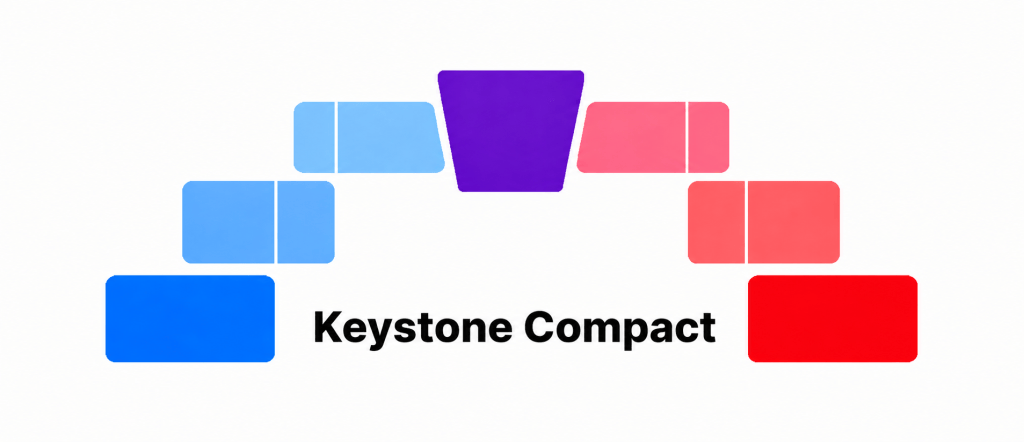
Keystone Compact: A Governing Alternative

The Keystone Compact is my effort to organize ideas about liberty, responsibility, government, and public life into a coherent framework. The views expressed here are mine. Agreement is welcome, disagreement is expected, and thoughtful common ground is the goal. The purpose is not to declare a final answer but to make these principles clear enough to be tested, challenged, and improved.

____________________________________________________________________________

America does not need a softer middle ground between fractured political tribes. It needs a disciplined governing philosophy grounded in liberty, responsibility, strength, and restraint. We are not short on political energy; we are short on governing discipline. One tribe seeks power strong enough to punish cultural enemies. Another seeks power broad enough to manage conscience and outcomes. Both warn against government abuse when the other side governs, then tolerate it when control changes hands.

The Keystone Compact begins with a refusal: citizens should not be required to trade judgment for belonging. This is neither centrism nor an average of two broken agendas. A bridge between two sinking ships remains a poor place to live.

Its core statement is direct: government should be strong where it must be, limited where it should be, and humble where it has repeatedly failed. It should secure rights, protect public order, defend the country, enforce fair rules and contracts, keep essential promises, and live within its financial reality. It should not manage private conscience, punish peaceful dissent, censor opposition, pick economic winners through political favor, subsidize irresponsibility, or mortgage the future for the next election.

Free Lives. Honest Budgets. Responsible Government.

Personal liberty is the default, but it does not include harming others. Rights must apply even to those we dislike. Social peace requires pluralism: citizens must remain free to speak, worship, marry, organize, raise families, and disagree without government harassment. Public safety and due process are not competing values. Order without rights becomes intimidation; rights without order become fragile.

Fiscal discipline is moral discipline because every unfunded promise has a future owner. Markets need competition, enforceable rules, and consequences for fraud—not exemptions for insiders. Safety nets should prevent ruin while restoring dignity, independence, and work, where possible. Decisions should remain close to communities whenever practical, so citizens can see results and hold leaders accountable.

Those principles lead to policies that will discomfort both tribes. Keystone supports balanced-budget discipline, pay-for rules for spending and tax cuts, and a simpler, flatter tax code that protects lower-income households, retirees, and small businesses. It would protect current Social Security and Medicare beneficiaries while fixing the math for younger generations. Health care should offer clearer pricing, stronger primary care, catastrophic protection, competition, and understandable choices. Education should combine strong public schools, family choice, vocational dignity, and one firm rule: public money requires public accountability.

The Compact takes a pro-choice position grounded in government restraint, where medicine, conscience, privacy, and bodily autonomy intersect. It affirms responsible citizens’ constitutional right to own firearms while insisting that rights and responsibilities travel together. It supports constitutional policing, due process, and firm consequences for violent and repeat offenders. On immigration: deport criminals, secure the border, respect work, modernize lawful immigration, protect genuine asylum seekers, and stop conflating cruelty with control.

National resilience requires practical discipline. Energy policy should be diversified, technology-neutral, and reliability-first, with energy sources judged by performance, cost, resilience, security, and environmental impact. Permitting should protect health and habitat without making needed infrastructure impossible to build.

Institutions also need repair before they harden into inheritance. The Compact supports constitutionally grounded, carefully phased 20-year active terms for Supreme Court justices rather than lifetime tenure and political roulette. Voting districts should use equal population as the controlling standard, applied through neutral, transparent criteria rather than partisan advantage or incumbent protection. Voters should choose representatives, not the other way around.

Abroad, the United States should support allies, strengthen NATO, resist authoritarian aggression, and defend its interests without writing blank checks. Military commitments should have clear objectives, oversight, burden-sharing, and an answer to the question, What next? Strength does not require silence, and loyalty does not require automatic agreement.

These priorities share a principle: maximum practical liberty, minimum necessary coercion, honest public accounting, and equal rules. That is the Keystone Test: Does a policy protect liberty, respect constitutional limits, show the bill, solve a real problem, avoid unnecessary coercion, preserve local flexibility, reduce favoritism, strengthen civic trust, and leave the country more resilient? If it cannot withstand those questions, it may be less about governing than about theater.

The Keystone Compact asks Americans to reclaim the habits of a free people: tell the truth, pay the bills, respect differences, defend rights, protect the vulnerable, reward work, punish corruption, question power, keep the lights on, and leave the country stronger.

Rights for everyone. Favors for no one. Power with limits. Policy with sense.

The series begins with the citizen. Before budgets, borders, courts, energy, or foreign policy, a more basic question comes: can Americans keep their judgment when the tribe starts chanting?

NeverFearTheDream………. W. C. Barron………. simplebender.com……….keystonecompact.org

-. — / -. . .– / – .-. .. -… . … / .— ..- … – / -. . .– / .. -.. . .- …


Lap Around the Sun: Daily Steps Forward
by WCBarron

Buy at Amazon Buy at Barnes & Noble Buy at Books2Read

Joy in Alzheimer’s: My Mom’s Brave Walk into Dementia’s Abyss
by WCBarron

Buy at Amazon Buy at Barnes & Noble Buy at Books2Read
Posted in Political

No Clear Path

What if you followed the rules? What if you left your family, risked everything on a dream, studied, worked, invested, and built a life around a single opportunity? What if, after doing everything asked of you, you discovered there was no clear path to citizenship? Worse, what if the permission that allowed you to build that life could change at the whim of an executive?

That is part of America’s immigration problem we rarely discuss. We talk about immigrants as though they were a single legal class. They are not.

Some entered the country unlawfully. Some entered legally and overstayed. Others came legally as students, researchers, workers, investors, refugees, asylum seekers, or under humanitarian protections. Their legal status—and their paths forward—are very different.

Refugees and people granted asylum can, currently, pursue permanent residence and, ultimately, citizenship. Qualifying Special Immigrant Visa recipients, including some Afghans who worked alongside the United States, can enter as lawful permanent residents.

But many other legal classifications offer no direct path. Students on F-1 or M-1 visas, exchange visitors on J-1, visitors on B-1/B-2, and treaty traders and investors on E-1/E-2 are here under temporary, nonimmigrant classifications. They may eventually qualify for permanent residence through other means, but their original status does not lead there.

Then there are Temporary Protected Status, DACA, and humanitarian parole. These can allow people to remain, work, study, raise families, and build lives here without providing a direct path to citizenship. TPS is temporary by statute. DACA is deferred enforcement, not lawful immigration status. Parole is temporary permission, not permanent admission.

That distinction matters because temporary protections can expire, be narrowed, terminated, or become entangled in litigation. Someone can follow the rules governing a program and still discover that the protection surrounding them has changed.

Following the rules should mean something.

We are equally careless when discussing immigration violations. Unlawful presence (i.e., overstaying a student visa) is generally a civil violation. Improperly entering the country is different. Under 8 U.S.C. §1325, a first improper entry is generally a misdemeanor. A subsequent improper-entry conviction can be a felony, and reentry after formal removal is a separate felony-level offense.

Those distinctions matter when deciding punishment, but they conveniently disappear when everyone becomes simply an ‘illegal’.

People accused of serious crimes should be arrested and stand trial. If convicted, they should be punished. Immigration status should not immunize anyone from accountability, but it shouldn’t be its sole basis of investigation and prosecution.

Accountability should remain tied to conduct, evidence, and due process. ICE/DHS data illustrate the distinction. An analysis of 438,537 people detained during the first fourteen months of the current administration found that about 3% had convictions for violent felonies such as homicide, sexual assault, or robbery. That does not mean the remaining 97% were all legally present or had no criminal history. It does mean that deportable and violent criminal are very different classifications. Arrests should be honest and focused, not just about meeting a quota.

When deportation is followed by confinement in a foreign prison, another question arises. That confinement is not merely the six-month §1325 penalty being served overseas. Removal, criminal punishment, and foreign imprisonment are distinct legal acts that require separate justification.

America benefits from immigrant labor in agriculture, construction, hospitality, and manufacturing; from foreign students and researchers in our universities and laboratories; and from entrepreneurs willing to invest their capital and ambition here.

We can enforce our borders without pretending everyone arrived the same way. We can remove dangerous criminals without treating every immigration violation as a violent crime. And we can insist on an orderly immigration system while acknowledging that the system itself is often anything but orderly, but it doesn’t have to be violent.

The question we should be asking: If someone follows the rules, shouldn’t there be a predictable rule for what comes next? If we choose not to offer a path, shouldn’t we say so clearly? And when the government changes the rules beneath someone who followed them, how much notice, proportionality, and due process does justice require?

A nation of laws should be strong enough to enforce them—and disciplined enough to distinguish between breaking the law and having the law change under your feet.

NeverFearTheDream   W. C. Barron   simplebender.com

..-. — .-.. .-.. — .– / – …. . / .-. ..- .-.. . …


Lap Around the Sun: Daily Steps Forward
by WCBarron

Buy at Amazon Buy at Barnes & Noble Buy at Books2Read

Joy in Alzheimer’s: My Mom’s Brave Walk into Dementia’s Abyss
by WCBarron

Buy at Amazon Buy at Barnes & Noble Buy at Books2Read
Posted in Political

Uniformity is the Exception

America was never built on agreement. It was built on managing disagreement without abandoning the republic. The great American myth is that we were once united in thought. The great American strength is that we never had to be.

From the beginning, Americans have passionately argued while finding enough common ground to move forward. That is why elections matter. Why opposition is legitimate. Why compromise is a necessity, not a nicety. And why today’s loser must always have the opportunity to become tomorrow’s winner. Violence belongs only as the last resort of last resorts—not the default response.

The Revolution was far from unanimous. Nearly one-fifth of colonists remained loyal to the Crown, while many others chose neutrality rather than rebellion. America did not begin with uniformity of opinion. It began with free people drawing different conclusions about the same future.

The Constitution was not born of unity. It was born of an argument. At the Constitutional Convention, Federalists and Anti-Federalists fiercely debated the proper role of government, individual liberty, and the distribution of power. People of different faiths, economic interests, regions, and priorities concluded that compromise was preferable to division. That wasn’t unanimity; it was constitutional and emotional maturity and a matter of survival.

Dissent has shaped our history. Manifest Destiny divided churches, politicians, and families. The Civil War was the tragic consequence of irreconcilable differences that remain unresolved even today. Americans argued fiercely over entering both World Wars. Reconstruction, civil rights, women’s suffrage, labor rights, women’s rights, immigration, and the role of government all sparked passionate disagreement. Every major turning point in our history has been accompanied by dissent, and its outcome has been shaped by it.

But through this, we have learned not to suppress disagreement but to channel it through the institutions designed for debate and resolution. Unfortunately, today those very institutions are losing their ability to seek compromise. Their representatives protect their own longevity and power and fear their tribe. The value of dissent is being lost for the sake of convenience.

The lesson and goal should never be to eliminate disagreement. Free societies do not survive because everyone agrees. They survive because citizens embrace disagreement as legitimate, necessary, and beneficial.

Today, we still disagree on morality, religion, citizenship, immigration, stewardship, ownership, individual rights and freedoms, and the proper role of government. None of that is new. What is new is the speed with which opinion becomes certainty, certainty becomes outrage, and outrage becomes identity. Immediate communication and unverified information often replace thoughtful research and debate with emotional reaction, making compromise seem like a weakness rather than a sign of wisdom.

The danger is not dissent. The danger is ignorant tribal certainty.

Opposing opinions are rarely obstacles to understanding; they are often its starting point. Every perspective brings experiences we may not have and assumptions we should question. Progress comes not from silencing disagreement but from listening long enough to find where another viewpoint can strengthen our own.

Every generation has believed the nation was coming apart. Yet the republic has endured. And it will unless we fail it. Uniformity has never been America’s way of operating. Dissent, argument, and compromise have been. Our national strength has never been in reaching the same conclusion. It has been in believing that those who reached different conclusions still belong to the same country under the same Constitution.

We see and hear the myth of discord’s devastation, but not the reality of its value. There is power and insight in opposing opinions. There is even greater power in understanding those differences and building on their strengths rather than attacking their weaknesses. Our greatest challenge is not learning to agree, but remembering that the freedom to disagree has always been one of America’s defining strengths. NeverFearTheDream simplebender.com

-.. .. … … . -. – / .. … / … – .-. . -. –. – ….


Lap Around the Sun: Daily Steps Forward
by WCBarron

Buy at Amazon Buy at Barnes & Noble Buy at Books2Read

Joy in Alzheimer’s: My Mom’s Brave Walk into Dementia’s Abyss
by WCBarron

Buy at Amazon Buy at Barnes & Noble Buy at Books2Read

Posted in Political

Beyond Tokenism, Tribalism, and Wokeism

The issues and consternation we face with Diversity, Equity, Inclusion, and Accessibility aren’t new. Humanity is predisposed to tribalism and discrimination. We like to be around those who are like us….whether race, gender, creed, hobby, or sports team. This country has had an issue with DEIA from its start. The idea that someone gets something to fill a quota rather than being the most qualified just isn’t American.

We stand on a merit-based system. As a country, we have struggled with DEIA laws thrust upon us since post-Civil War reconstruction and especially since the Civil Rights Act of 1964. We reject the concept of merit and privilege being replaced with legislation trying to eliminate discrimination because the result is systematic alienization and reverse discrimination.

Diversity is not just a preference; it’s a necessity in business, sports, education, social interaction, and life. The ideas, experiences, prowess, and insights of other nationalities, races, genders, and creeds enrich our lives and country. It’s a vibrant aspect of our nation—a nation of immigrants.

Equity is not equality. It’s about ensuring everyone is on an equal footing. The privileged should not be treated any better or worse than the impoverished, and the rich should not have any more access to political officials than the hoi polloi. The challenge is: How can you ensure equity when the playing field has never been level? None of us start with the same privileges or handicaps. Treating everyone equally only perpetuates and extends inequities. And if you believe the education system and/or medical care in this country is equal for all, you’ll struggle to understand any of this.

We stand on a merit-based system. We reject the idea of nepotism and ‘pay to play’ influence. Right? Yet, we all know the person who got the job because their parent knew someone, had money, or owned the company. We stand on merit, right? I understand the frustration with DEI. I was once told I would hire a specific person for an open, publicly posted position. The job description was unambiguous. Looking at the resume, the new hire didn’t appear to be a good match, but that didn’t matter. Quickly checking my DEI card, I recognized there was, in fact, justification for the hire, regardless of qualification. The new employee was part of an exclusive minority. With a little extra time, patience, and training, the company finally had a good employee. The child of a sitting U.S. Senator allowed us to check a box and have an amazingly unique perspective at break time. Merit didn’t matter then; to some, it doesn’t matter now. Of course, the good-ole-boy, nepotistic system was always so much better in so many ways, right?

Remember that DEI never intended to mean ‘Don’t Ever Integrate.’ It was meant to be a way to give opportunities to all people, not just those with connections. Is the current direction and directives about merit or returning to our country’s quasi-legal racial segregation state? As cop killers and killing cops are pardoned, the answer may already be self-evident. Courage and Be Bold   

#NeverFearTheDream   simplebender.com @simplebender.bsky.social

This was first printed in the Bend Bulletin 1/30/25 titled: Measuring merit and diversity