Featured
Posted in Philosophy

When Bonds Become Bondage

the soft wood bridge building bonds turn to chains of bondage quickly....simplebender.com

Bonds are built on trust and shared purpose. What begins as social alignment can harden into dependency and quiet surrender. We’re encouraged to join teams, tribes, and causes—to belong. But what happens when those bonds start to dictate not just our identity, but also what we’re permitted to think?

Healthy bonds help us carry burdens, share experiences, and grow. They give us identity, protection, and the comfort of not standing alone. Long, strong bonds take effort: listening, repair, and the freedom to disagree without being cast out.

Yet the same bond that holds us up can also hold us down. It becomes bondage when internal disagreement feels like betrayal and outside questions feel like an attack. When you sense that leaving—or even doubting—will cost you your status, your income, your family, or your place at the table, you’re no longer just bonded. You’re being managed.

This innocuous type of bondage isn’t so bold as handcuffs. It seeps in through reward and punishment. Praise for loyalty. Shame for dissent. Fear of exile. Our “independence muscle” atrophies, not only because we stop using it, but because the systems around us—media, parties, teams, neighborhoods, companies, even congregations—profit from our reflexive defense of the group. We start repeating talking points. We don’t think or challenge; we begin to become puppets. Their script becomes our voice.

And yet, people don’t choose this only out of weakness or neglect. Tight bonds promise safety in a chaotic world. They offer clear enemies, simple answers, and the warmth of “us.” Sometimes bondage feels much better than isolation.

That’s why we need quiet tests of our own chains. When was the last time you openly challenged your group’s beliefs, and how did they respond? If you walked away tomorrow, what would you truly lose—and what might you gain?

Society survives through bonds—and through resisting the slide into silent obedience. So yes, build bonds. But also actively seek out and connect with those who think differently, and to those your group teaches you to fear or mock. Cross-group ties don’t erase convictions; they loosen the hidden shackles of certainty.

Stand with others, not under a thumb or behind a shield. Bonds are necessary—bondage is optional and may not be escapable. NeverFearTheDream   simplebender.com

For Every Problem...A Solution...
Lap Around the Sun: Daily Steps Forward
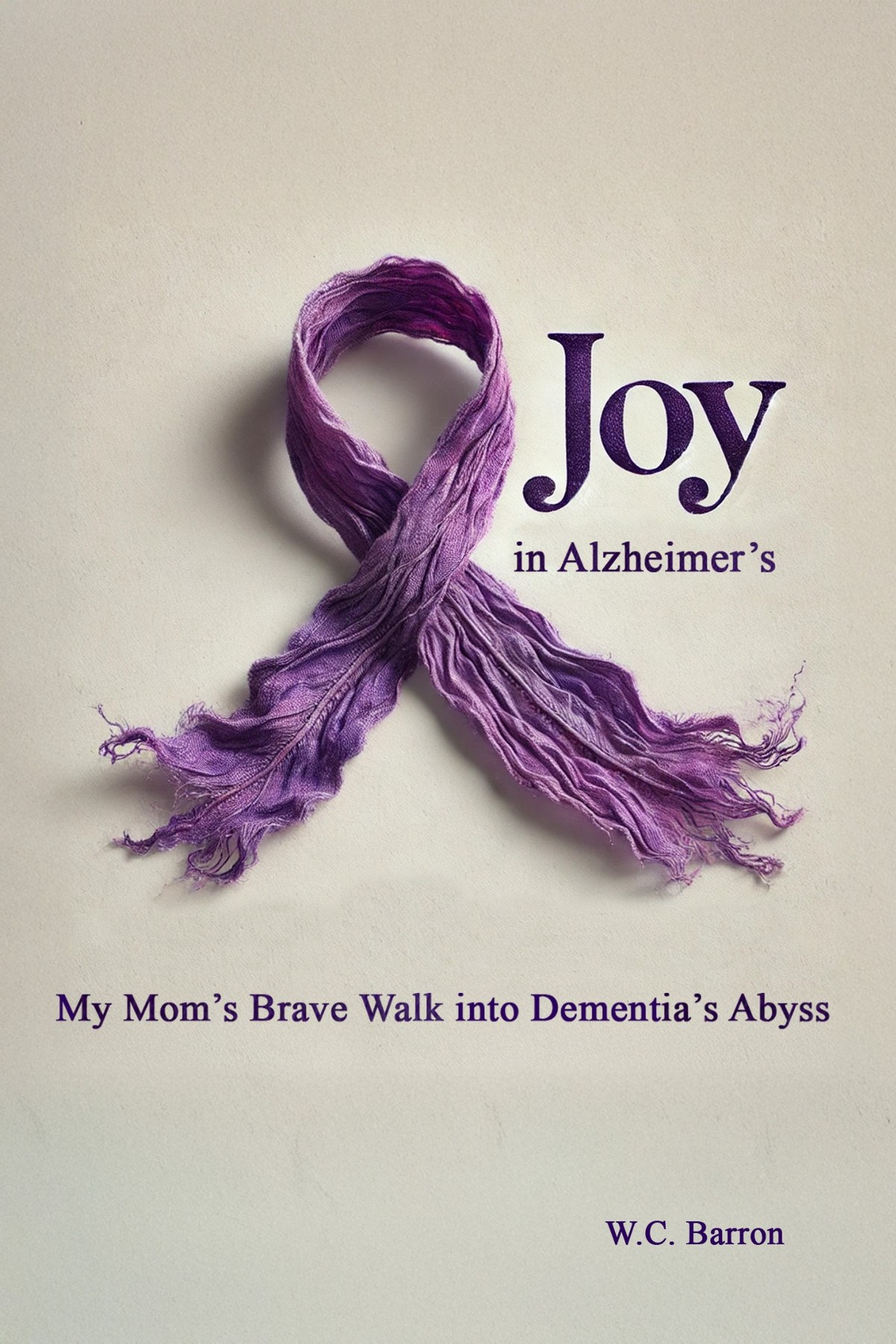
Joy in Alzheimer’s: My Mom’s Brave Walk into Dementia’s Abyss

Featured
Posted in Philosophy

Credibility: The Fragile Currency of Character

Credibility is a delicate characteristic — slow to earn, swift to lose, and nearly impossible to fully restore. It’s like a crystal goblet: clear, strong in purpose, yet so easily fractured by careless acts. Once shattered, even after the best repair, the cracks remain visible and weak, and the goblet, once pristine, is forever damaged. Those who’ve tried to rebuild their chalice of credibility know the haunting truth — it becomes easier to break again, and probably will. Credibility doesn’t erode overnight; it erodes through capitulation, excuses, and the convenience of shifting with the wind.

There was a time when credibility was among our highest personal currencies and a source of pride. A person’s word was their bond. Their handshake was a contract. Their consistency was a mirror of their moral compass. Their willingness to admit mistakes and change positions in light of new information was seen as extreme emotional maturity and self-confidence. Perfection doesn’t—and didn’t—earn credibility, but integrity does. A visible, demonstrated alignment between belief, speech, and action. Today, that alignment is bent under the weight of expediency and twisted for target audiences.

The credibility of leaders — political, pulpit, legal, law enforcement, academic, athletic — has become collateral in the age of populism and applause metrics. When polls become the goal, truth becomes negotiable. When power is the aim, credibility is an afterthought, and diversion and deceit are the tools of choice. The words ‘I promise’ and ‘trust me’ become code for watch your back. We see it in leaders who flip their stances to appease whichever crowd can give them more leverage. They conveniently forget that credibility is built through conviction and compromise—not appeasement. It’s not the stance itself that matters most; it’s the steadiness of principle that gives credibility its meaning.

In this swirling chaos of contradiction and convenience, we, and the world, have grown cynical. Our long-standing allies no longer trust our national commitments. Those who stand ‘against us’ leverage our lack of credibility to their advantage.

We no longer trust what’s said, only what’s repeated—and if a lie is told often enough and loud enough, some believe it to be a truth—but it’s not, it’s still a lie—with or without a sprinkle of truth to placate the gullible. And, unfortunately, when the truth is actually told, we are all skeptical, uncertain, with no clear way to confirm or deny—so, everything feels like a lie, or a hybrid truth.

We no longer follow those who lead — we watch to see if they’re trending. We analyze ten-second snippets or AI-generated memes designed to slander and divide, not unify. In doing so, we participate in the erosion we claim to despise—we, the people, become willing players in the deceit and the shattering of credibility.

We need to stop outsourcing integrity and credibility. Stop waiting for heroes to save us, saints to guide us, or perfect voices to speak for us. The world doesn’t need any more idols, demigods, or people placed upon false pedestals. It needs individuals who live as examples — quietly, calmly, patiently, consistently, courageously.

Let’s stop looking for heroes and start being credible ones — with every choice and every word you make every day.

For Every Problem...A Solution...
Lap Around the Sun: Daily Steps Forward
Joy in Alzheimer’s: My Mom’s Brave Walk into Dementia’s Abyss

Featured
Posted in Philosophy

Rediscover Your First Nature: Beneath the Vener of Your Second

Every day, we hear people declare, ‘This is just second nature.’ For something to become second nature, there had to be practice and/or social influence to change what their first nature was. Does anyone remember what their first nature was, and can we peel back the veneer of our second to return to the first, if we wanted to?

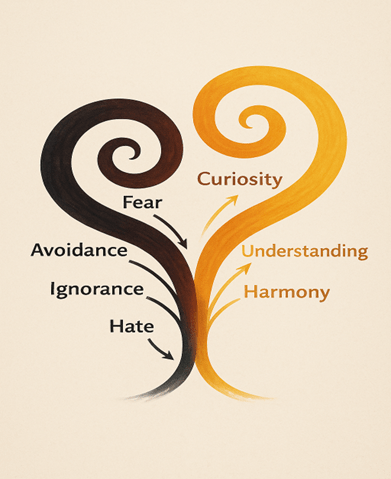
We rarely talk about our First Nature. The nature we were blessed with in the beginning, before we were conditioned and formed life-altering habits. They are the innate, biological, pre-social capacities of curiosity, fear, empathy, attachment, and so on. First nature doesn’t hate; it differentiates. It notices patterns of familiarity, comfort, threat, and protection. It produces the capacity for bias, but it doesn’t develop an ideology of it.

Second Nature is learned, habituated, and socially enforced structures of behaviors and beliefs. When a reaction or attitude becomes second nature, it means it has been so deeply culturally engineered that it feels automatic—a reflex done without thinking. Second nature is encoding through stories, rituals, hierarchies, and reward systems. Hate and bigotry are not natural; they are second nature; they are a cultural metastasis of a cycle.

Run the loop long enough and hate feels ‘natural’—it is second nature and doesn’t feel like a negative response or reaction, it just merely is—because you’ve been socially corrupted and molded.

A thoughtful person in reflection must ask: Can it be reversed? The answer is a resounding yes. It can if we recognize the cycle. Instead of fear-triggering avoidance, what if it triggered natural curiosity? This shift in perspective opens up a world of possibilities for growth and change.

This isn’t sentimental. It’s disciplined work: notice the trigger, interrupt the habit, and retrain the response by consciously choosing a different reaction. The task isn’t to erase second nature but to realign it—so what feels automatic again serves what is authentic.

We are defined by what we love and what we detest, what we accept, what we tolerate, and what we reject. Each of us can rediscover our first nature characteristics. Because first nature doesn’t have a set of instructions, rediscovery isn’t about reprogramming yourself but about acknowledging that you are a product of your socio-economic environment. Take time to reflect and, honestly, aggressively self-assess. Self-deception is self-deprivation—denying yourself the truth denies you growth. But when you embrace self-reflection, you take control of your growth journey. Ask yourself if the second nature virtue you exhibit is really a tortured, misconfigured, misaligned first nature—like fear yielding to hate. Give yourself the latitude and patience to look deep, rediscover alternatives, and be open to the power of curiosity and understanding.

For Every Problem...A Solution...
Lap Around the Sun: Daily Steps Forward
Joy in Alzheimer’s: My Mom’s Brave Walk into Dementia’s Abyss

Featured
Posted in Philosophy

When Ten Is Just Too Many…

Encourage ethical living through four simple principles

The bridge of life over turbulent river supported by four critical spans....

Religions and philosophies have long sought to distill the principles of life into something memorable and enduring. The story goes that Moses ascended the mountain to retrieve the Ten Commandments for his people. Ten was supposed to be simple. Yet if today’s headlines are any measure, ten is too many for too many. So let’s cut to the core—four principles that are not bound by any specific belief system, but are universal and can be practiced by anyone:

Act with reverence to all.
Cultivate generosity.
Be considerate in relationships.
Tell the truth with care.

Act with reverence to all.
The key phrase is to all. Reverence means respect, grace, and honor—offered not just to friends or allies but to those who oppose, insult, or dismiss you. You don’t have to like or agree with someone to treat them with dignity. Doing so shows moral maturity, honors both of you, and sets an example—even if it isn’t returned.

Cultivate generosity.
Generosity isn’t about giving away everything. It is a practice of timely kindness—offering what is needed, when it is needed, to whomever needs it. Like any skill, generosity grows through practice until it becomes second nature.

Be considerate in relationships.
Every intimate relationship carries hope and vulnerability. To honor that is to see beyond the carnal into the emotional and intellectual—embracing another’s fears and dreams without violating them. That takes openness and courage. And once you learn it in intimacy, extend it outward—adjusting the degree, but carrying consideration into every human interaction.

Tell the truth with care.
Truth matters—but it can wound. Some truths people bury, rewrite, or try to cancel because they hurt. Still, the truth must surface. The key is how we share it: directly, yet not cruelly, honestly, yet not demeaning. Speak truth the way you would want to hear it yourself. And remember, truth is rarely black and white; perspective adds the shades of gray that make it whole.

Headlines are filled with destruction, hatred, and division. We can’t stop it all. But each of us can live by these four guardrails. They are not lofty commandments carved in stone, just four simple principles to practice every day. Because ten may be too many, but we can manage four:

Reverence. Generosity. Consideration. Truth.

For Every Problem...A Solution...
Lap Around the Sun: Daily Steps Forward
Joy in Alzheimer’s: My Mom’s Brave Walk into Dementia’s Abyss

Featured
Posted in Political

Rabbits’ Revenge: A Fable of Hidden Strength

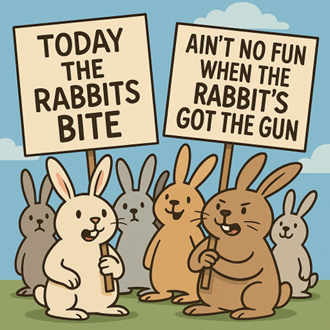
Protesting 'Rabbits' Ain't No Fun When the Rabbit's Got the Gun

King Wannabe stood before the crowd of people, his back hunched, too feeble to be erect, his greying, bushy eyebrows raised, his face twisted in contempt. The people would not chant his name nor bow to his image. “Rabbits,” he scoffed. “Nothing but rabbits. They eat, they breed, they exist for my pleasure. Especially the young ones—for my pleasure. Everyone must love Wannabe, everyone, especially these rabbits.” His entourage knelt in obedience, fearful of his rage.

One brave advisor dared to whisper, “But sir, no one is loved by everyone, and they are more than rabbits. They are people, with minds, with hopes and dreams.” In a buffoonish manner, Wannabe waved the thought aside, clutching a handful of pamphlets. “Look at these. Lies! All lies! Their words are filth. Take their paper and their pens. Silence them, cancel their culture.” He signed an Order, and the dutiful minions obeyed, seizing what they could.

Yet the words did not stop. Thought traveled without ink. Discontent spread without parchment. And so Wannabe tightened his grip. In a tyrannical rage, he yelled, “We will control the news. We will make them pay to speak. We will force them to listen. We will tell them what books to read. We will be their favorite, the one they love; they will love Wannabe.” Again, with trepidation, the advisor leaned close: “But sir, even without paper, they have found their voices. They still have minds. And even rabbits, when cornered, will bite. Not today, perhaps—but one day the rabbits will bite. Remember this if you remember nothing at all. And heed the hunter’s satire.” The Wannabe dismissed him with a bitter laugh and a sneer. “Nonsense. They are only rabbits. They are for my pleasure; their only care is to eat and breed.” He arrogantly sneered. “And as to the satirical, I hate comics: ‘ain’t no fun when the rabbit’s got the gun’ is just silly. It’s for the weak and timid; not for Wannabe because Wannabe controls all and fears nothing.” He laughed, but his laugh was uneasy, and the silence from his minions was unmistakable and deafening.

Seasons passed. The whisper and wisdom of the sage advisor lingered. The people—mocked as useless, underestimated lagomorphs—grew weary of abuse and felt more cornered yet bolder. The self-serving advisors, sensing doom, scurried away with whatever spoils they could steal. At last, Wannabe stood alone, his armies and decrees powerless against a multitude no longer afraid, but resolute and united.

And from the crowd, like sparks catching fire, came the clamorous chants:

“Today the rabbits bite.”
“Ain’t no fun when the rabbit’s got the gun.”

Protesting against authoritarianism

The chants rolled through the streets, half warning, half laughter, but all serious. It was no threat of violence, but a proverb of irony. These people, these ‘rabbits’, had never needed literal guns because they had found something much more lethal—strength in their numbers, in their unified ideas, in their memory, dreams, and words, and now in their collective refusal to bow. The chant was their laughter, their truth, their declaration that the world had turned and change was in the offing. And the wise sage smiled a subtle, small, sly smile, always knowing and anticipating the power of their unity.

Civil society thrives only when none are treated as beasts, but as human beings with voices, hopes, and dreams. Wise leaders understand that thought is stronger than chains and the pen is stronger than the sword. The silencing of truth and thought control is always temporary; revolt begins the moment words are stifled, and action follows when endurance breaks.

If you have a gun—put it down, and put it away, we rabbits don’t need them.

Instead, pick up your pen and write your thoughts and dreams. Raise your voice and speak your mind. Open your ears and listen to others. Kings, Emperors, and wannabes are mortal. But thoughts endure. Words endure. And yours are essential. #Ain’tNoFun

For Every Problem...A Solution...
Lap Around the Sun: Daily Steps Forward
Joy in Alzheimer’s: My Mom’s Brave Walk into Dementia’s Abyss

Featured
Posted in Philosophy

Life’s Continuance

We all look at life, and death, differently. Some differences are subtle, others dramatic. Some lean heavily upon religious practices and beliefs to understand and cope with the unknown. Others seek solitude and find solace in nature’s quiet while they calm their minds to calm their souls. Neither approach is right nor wrong, inferior, or superior. They are simply different means to reconcile life, life’s end, and the unknown nature of life after death.

What if there was no death but only a continuance? What if there is an ‘after-life’ of soul and body? Indeed, there is an end to our physical manifestation, but is that the entirety of existence? Or do we continue through our families and the generations to follow? A never-ending continuing sequence in humankind.

Look at your hand, what do you see? Do you only see your hand, your skin, your blood vessels, your skin cells? Is that all you, see? Look closer, I see all those but also, I see my parents, and their parents, and theirs before them and farther still. I see a continuum of life. A never ending always building continuance. Every cell in my body has the genetic sequence of my family past. While unique, I am not new. I am a product of the infinite interactions of all my forebears and theirs.

Look at your child’s hand and the hands of their children. Look closely. There it is. There you are. And there is your family’s past. You are a part of them. You always have been and always will be. You will always be a part of the future generations to come as well.

While you are part of them forever, they are also part of you. You cannot separate yourself from a part of something of which you are integral. They will continue after your physical form is gone. They will carry your memories and your teachings, good and bad, and pass them on to others. More importantly, you will always be with them, a part of every cell within them.

Look at your children holding their children’s hands and know you are holding their hands as well. Even if you are not there physically, you are there and always will be. There is no passing, only a continuance. No death; as life goes on.

NeverFearTheDream

Featured
Posted in Political

Fix America’s Broken Windows

When you own a factory, you don’t tear it down when you have a few broken windows. You fix the windows. But if you don’t fix them, your neighbors and passersby know you are in trouble. You appear not to care or are incapable of fixing your problems. Soon there will be more broken windows, as your factory falls further and further into disrepair.

America is like a factory. A sprawling dynamic complex with many buildings and a lot of windows. Unfortunately, the American Factory has a few broken windows, and a very few really want to fix them. The majority want to spend a lot of time, money, and energy yelling and pointing fingers at issues which might not really be of much value. They focus on hate generated topics like ‘woke’, transgender, and LGBTQ. These are issues reflecting differences of opinion and personal preference. The vocal body focuses on the fabrication of election rigging conspiracies and the undercutting of our election and judicial systems. Why do we find the time to breed hate but not understanding?

We don’t make time to prioritize fixing the broken windows of fentanyl, mental health, or the homeless. Others may see other broken windows, yet if we can fix these the other windows might not be broken, just cracked and chipped and much easier to repair.

Annually, tens of thousands of Americans are dying by overdose and their families broken because of it. The addiction is fueling our homelessness crisis and filling our streets with refuse and discarded, broken, human beings, as well as our morgues. The mental health crisis feeds drug abuse and is disproportionately impacting minorities and under-educated. These are our broken windows. We seem only interested in sweeping up the glass off the factory floor and not willing to focus upon fixing the windows. It doesn’t matter who broke the window, or maybe not even how; but we must fix them lest more are broken.

We don’t want to solve the problem, nor face it. We want to blame someone. It’s easy to cast blame and harder to fix the problems. It’s easy to blame the southern border immigrants for breaking the window. But, have you looked at the immigrants; really looked. They are carrying a few clothes in shoddy backpacks and their children, not pounds and pounds of drugs. Stop blaming them and start looking for and solving the real cause; us. Consider, information from DEA, ICE, and DHS (1);

  • 90% of fentanyl seizures are at legal border ports of entry, not immigration routes;
  • Over 90% of those seizures are from U.S. Citizens, not immigrants;
  • Less than 0.02% of arrested immigrants possessed any fentanyl;
  • U.S. citizens exceed 85% of the convicted drug traffickers, ten times greater than convictions of undocumented immigrants.

Ultimately, fentanyl smuggling is funded by us, U.S. citizens, the consumers. If we want to stop the fentanyl problem, let’s start asking why so many of us are becoming addicted. Why are so many taking these opioid drugs in the first place? What pain, emotionally or physically, what desperation, is so great they require these intoxicants to cope? Answering, ‘How did we get here?’ might help us fix the window before more lives are destroyed.

If we have time to focus on hate and festering ego issues, with legislators paralyzed by radical party extremes we have time to fix windows. These are shining examples of why the American Factory windows are being broken faster and faster. Our neighbors see us as a decaying, broken factory which cannot address our own real problems mired in dysfunctionality. Put partisan rhetoric aside, face the big problems, and at least be seen trying to fix the windows rather than trying to tear down the factory.

(1) www.cato.org/blog/fentanyl-smuggled-us-citizens-us-citizens-not-asylum-seekers

This article was first published in the Bend Bulletin 10/24/23

Featured
Posted in Joy In Alzheimer's, Philosophy

Joy In Alzheimer’s

Prologue

Let’s just be honest; there is no joy in Alzheimer’s; however, Joy, my mom, is in the middle of it….so ‘Joy In Alzheimer’s’ is where we are. This is an attempt to follow her through this unwinnable battle. To open-up about how the mental disease affects her and those who care and love her. So, how did her long journey down a narrowing path come to this point. A path which no longer has a safety net. Where every stumble, on her old uncertain legs and weakened mind, can lead to uncontrolled dementia and deep dark recesses.

Joy’s road, like most with Alzheimer’s, started long before anyone really knew. My dad passed away over 15 years ago and since then Joy has lived alone. My nephew and his family lived nearby for several years. To their credit they reported subtle changes in her mental abilities. Being remote, the rest of the family dismissed the observations as ‘she’s just getting older’. Six years ago, we moved her from her west Texas home of over 50 years to an independent living facility in central Oregon. Now closer, we could see some subtle changes which age alone couldn’t explain. Three falls, with head injury, just compounded the problem. She began to lose the ability to pay bills and her ‘book-keeping’ went from taking a few hours to taking a few weeks.

We took her to a neurologist under the pretext of getting a baseline assessment after her third fall. The appointment went well. The neurologist wasn’t overly concerned with her cognitive test results. The diagnosis changed at the next appointment six months later. The doctor was concerned with the delusional episodes, the money management deterioration, but the illustration below sort of tipped the scales.

Within six months we had moved her to an assisted living facility, before the independent one was forced to ask us to move her. That’s where she is now and has been for over a year and a half; even though she’ll tell you she just moved in and has changed apartments five or six times, and the entire complex has been rotated around several times.

This was the start of our journey with her down that long narrowing path. We have found humor, character, courage, and sadness along the way. I’m sure we will find more as we continue. These will be the stories I tell, and I’m always interested in comments and support as we try to help each other. We are all on journeys and we shouldn’t judge the paths we are all on. We should just extend a hand and help. You never know, you might be the safety net so many of those with Alzheimer’s and those who are their care partners really need.

NeverFearTheDream simplebender.com @simplebender.bsky.social Stand For Truth

Featured
Posted in Political

Old Glory and Her Companions

Recently, I’ve spent some time driving through several urban and rural parts of America and something struck me. I noticed a lot of American flags flying. Some were crisp, clean, and clearly new. Some were tattered and worn. Some were damaged by smoke and flames from forest fires, yet they survived. I saw the red strip as well as the blue strip.  Most waved majestically, stars aloft. A very few flew resolutely upside-down declaring distress. The flag of the Republic fluttering in the breeze silently representing all of us regardless of our political position. You see the flag doesn’t know or care what you believe. It simply waves, the light dancing off the symbolic colors and independent, yet clustered, stars.

What struck me the most was the flags which joined Old Glory. Those are the flags which might just tell the real story of belief and maybe disbelief. I saw the State’s flag symbolically flying subserviently. I saw the flag remembering those Missing In Action (MIA) and the sacrifice they and their families have made and solemnly wished them well. I saw crisp, new, clean Ukrainian flags the bright yellow and blue sending a strong message and wished them peace and strength. I saw the Rainbow flag. I saw the Gadsden flag and pondered if the those flying it knew its history and that of the Continental Marines which it represented. I saw flags of the failed Confederacy and of South Vietnam and wondered.

But the grouping which was most gripping was a tri-pole flying an inverted, half-staffed, American in the center, a ‘Brandon’ flag to the left and a Russian flag to the right. As I passed, I was glad those responsible for the display had the right and freedom to do so. And yet wondered about those flying the MIA and/or the Ukraine flags and the messages each cluster was sending.

Maybe the few inverted flags were the most symbolically honest. Maybe we are a divided country in distress. Division only benefits our detractors and enemies. Maybe we should disarm our polarized positions and recognize, despite ourselves, we are stronger together than apart. Let’s not let them win.

Dream

Posted in Philosophy

Friends are a Choice

True friends are solid rock under your feet. Those who befriend for personal gain are shifting desert sands.

You’re born into a family. There’s a bond there; sometimes warm, sometimes strained, but it exists whether you asked for it or not. Friends are different. Friends are chosen. You choose them, and more importantly, they reciprocate that choice.

Some friends come from our reckless, impetuous youth. Some from our careers. Some from neighborhoods, teams, projects, and the accidents of geography. Time and distance shuffle the cast, but the real ones don’t become strangers. They steady you. They don’t demand a performance. They can disagree without turning you into a defendant. You remember them fondly, and when you see them again after years, you can still pick up mid-sentence, as if time never got a vote. That’s friendship. Not constant contact. An unshakable bond. These are the people you brought into each other’s lives, not for gain but for mutual support.

But there are others. People who orbit you for their own advantage. Their support is there—until it costs them something. Their loyalty is conditional. Their kindness comes with a receipt. They keep score, question motives, and disappear when you’re inconvenient or irrelevant. These relationships can be helpful, even mutually beneficial, but they’re transactions, not friendships. The difference between them is where people get hurt. With transactional allies, trust is offered in exchange for leverage.

Choose wisely, not selfishly. Choose friends for support, and benefits will often follow. Choose people for benefit, and deception shouldn’t surprise you. NeverFearTheDream simplebender.com

Joy in Alzheimer’s
W.C. Barron
Lap Around the Sun
Daily Steps Forward — W.C. Barron
Posted in NeverFeartheDream

Never Fear The Dream…

Awakening means observing what truly is—not what you wish it to be—over and over until the truth becomes obvious. Awake from your dreamy slumber and embrace life’s reality. 26.01.3

Joy in Alzheimer’s
W.C. Barron
Lap Around the Sun
Daily Steps Forward — W.C. Barron
Posted in Current Events, Political

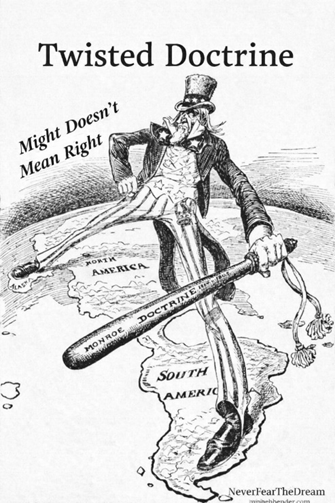
American Hypocrisy: Twisted Doctrine

The Monroe Doctrine was meant to be a shield for a fledgling country: no European empires in the Americas, no more carving up this hemisphere by outside powers. It sounded like a defense of sovereignty and self-determination. Two centuries later, that shield has been reforged into something else—a license to police the hemisphere and enforce an American Hemispheric Order on our terms.

We claim to oppose foreign domination, yet we have become the dominant foreign power in other sovereign countries. When a government in the region dares to stray from our economic dogma or security script, we don’t send in Redcoats—we threaten and impose sanctions. Loans are conditioned. Sanctions are tightened. Diplomats whisper, intelligence agencies “assist,” and suddenly regime change appears not as an invasion but as a “restoration of democracy.” The vocabulary is polite; the outcome is familiar. Governments that cooperate survive. Governments that don’t are labeled unstable, extreme, or illegitimate. It isn’t about drugs, oil, or national security—it is about ego, power, and distraction from domestic failures and salacious files.

Flip that. Imagine a coalition of Latin American nations deciding that our politics are too corrupt, our inequality too obscene, and our elections too tainted by money. Imagine they declare an “Inter-American Responsibility Doctrine” and openly call for regime change in Washington to protect “hemispheric stability.” Picture them funding opposition groups, manipulating our media, freezing our assets, and threatening intervention—“for the sake of democracy,” of course. We would be apoplectic. We would call it aggression, pure and simple.

The hypocrisy deepens when you look at security. We pressure neighbors to crack down on crime, migration, and drugs, as if their failures are the source of our problems. Yes, trafficking networks and corrupt officials exist everywhere. But the demand, the guns, and much of the money flow from our side of the border. Rather than confront the discomfort of our own consumption, our own political greed-induced paralysis, and our own profit structures, we cast the neighbors as the problem and ourselves as the savior sheriff.

We insist on the right to shape their regimes while insisting no one has the right to shape ours. We dress intervention in the language of freedom while guarding our own system—flawed, gridlocked, and heavily purchased—as untouchable. It’s a double standard that everyone can see, whether we admit it or not. So here’s the uncomfortable mirror: if the rest of the hemisphere treated us exactly as we treat them—economically, politically, and rhetorically—would we still call it “promoting stability,” or would we finally call it what it feels like to them: unwelcome domination dressed as doctrine for ego and power?   NeverFearTheDream   simplebender.com

Joy in Alzheimer’s
W.C. Barron
Lap Around the Sun
Daily Steps Forward — W.C. Barron
Posted in Philosophy

Focused Past—Blurred Future

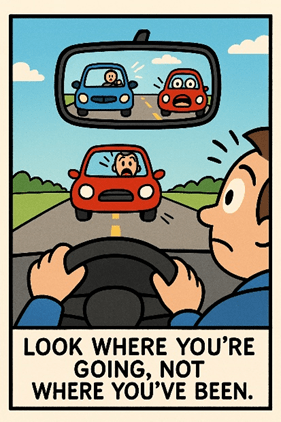
cartoon showing looking backwards and not forward will cause a wreck

People who stop overanalyzing the past have better odds at a successful future.

There is value in embracing the past and looking to the future simultaneously—to practice the philosopher’s “Janusian mindset”—while staying present in the moment. Yet, as we age, whether as individuals or nations, we tend to focus more on our past. We romanticize times when we felt invincible—periods of vitality, learning, and growth. We were finding our strengths, supporting and hiding our weaknesses, all the while learning to see the same in everyone around us.

Now, here we are—a little older, slower, and weaker, but much wiser. And therein lies the key to our future. The secret is not to dwell on who we were, but to leverage our accumulated knowledge and experience for the good of those around us. Greatness is not measured by what we’ve done, but by how we uplift others. As individuals, it’s in how we help our communities; as a nation, it’s in how we inspire global respect for democracy and human dignity. This is the message that philosophers, teachers, and prophets throughout history have conveyed. Greatness was never about personal glory—it was about collective well-being.

Let’s focus less on what we were and more on what we can become, using our experiences to encourage, not oppress. Let’s leverage those experiences not to oppress but to encourage and uplift. The sacrifices of the “Greatest Generation” showed us that we should stand up for those who suffer and support the vulnerable, both locally and globally. We, too, can inspire by looking back as we move forward, coaching the next generation to be better. We must be mindful of what we teach and how we act; the next generation and the world are watching — everything. Our ability to influence and guide them is directly related to our credibility.

Staring in the rearview mirror is a great way to have a wreck while driving forward. As this year ends and we begin another lap around the sun, glance back with gratitude, acknowledging the memories, but keep your eyes focused on the future—for all of us. NeverFearTheDream simplebender.com

First published in Bend Bulletin 1/7/26

Joy in Alzheimer’s
W.C. Barron
Lap Around the Sun
Daily Steps Forward — W.C. Barron

Posted in NeverFeartheDream

Never Fear The Dream…

Your Dreams should be chased not feared.....
NeverFearTheDream  simplebender.com

When not based on ego or anger, genuine compassion is a fearless emotion. 26.01.2

Joy in Alzheimer’s
W.C. Barron
Lap Around the Sun
Daily Steps Forward — W.C. Barron
Posted in NeverFeartheDream

Never Fear The Dream…

Your Dreams should be chased not feared.....
NeverFearTheDream  simplebender.com

There is a union among self-discipline, self-deception, and self-forgiveness. Within that space, you will find yourself. 26.01.1

Joy in Alzheimer’s
W.C. Barron
Lap Around the Sun
Daily Steps Forward — W.C. Barron
Posted in Current Events, Political

Protection of Dissent

Decent people support dissent   NeverFearTheDream  simplebender.com

Democracies don’t die when people stop agreeing; they die when people stop dissenting. The loud, awkward, sometimes offensive voices are not a nuisance in a free society—they’re proof the system is still breathing.

We like to think “decency” means keeping things calm and polite. But genuine decency involves the courage to say, “This is wrong,” when power would rather you stay silent. The “decent” citizen who never questions authority isn’t truly decent; they’re just obedient.

That’s why dissent is always the first target of any controlling system. Not murderers. Not fraudsters. Not the genuinely dangerous. No, the temptation is to start with the inconvenient. Today, that often means immigrants, students, and visa holders. ICE and DHS don’t just police borders; they’re increasingly policing opinions—trawling social media, flagging protest, and turning lawful speech into a quiet risk factor for deportation.

On paper, the First Amendment belongs to “the people,” not just citizens. In practice, the easiest place to test new forms of control is with those who have the weakest political footing. If you can punish an international student for a tweet, you’ve just built a working model of speech control that can be scaled later. The laboratory is immigration; the product can be rolled out to everyone else.

That’s where the “protection of dissent” comes in. If decent people, like us, sit this out because they dislike the protesters’ slogans or hashtags, they’re missing the plot. The issue isn’t whether we agree with the content of dissent. The issue is whether the government can quietly attach a price and a punishment to dissent, leaving only the reckless or the desperate willing to speak.

History is blunt: once it becomes dangerous to disagree, it eventually becomes dangerous to be different.

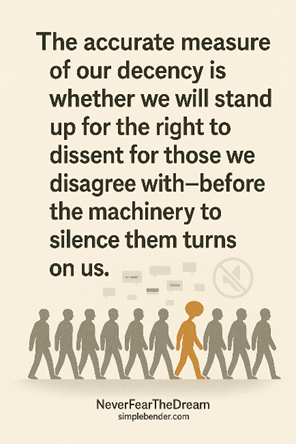
The accurate measure of our decency is whether we will stand up for the right to dissent for those we disagree with, before the machinery to silence them turns on us. NeverFearTheDream   simplebender.com

Joy in Alzheimer’s
W.C. Barron
Lap Around the Sun
Daily Steps Forward — W.C. Barron

Posted in NeverFeartheDream

Never Fear The Dream…

Your Dreams should be chased not feared.....
NeverFearTheDream  simplebender.com

You arrive with nothing and leave with nothing—but what will you leave behind? Don’t let your perceived insignificance keep you from doing something significant.  Now it’s your turn.25.12.5

Joy in Alzheimer’s
W.C. Barron
Lap Around the Sun
Daily Steps Forward — W.C. Barron
Posted in NeverFeartheDream

Never Fear The Dream…

Your Dreams should be chased not feared.....
NeverFearTheDream  simplebender.com

Better to look the fool than be someone else’s. Don’t take yourself too seriously—the mighty and the meek share the same final chapter. Before you start your journey, ask if you’re prepared for the hardships or if you’re chasing the glory. 25.12.4.1

Joy in Alzheimer’s
W.C. Barron
Lap Around the Sun
Daily Steps Forward — W.C. Barron
Posted in NeverFeartheDream

Never Fear The Dream…

Your Dreams should be chased not feared.....
NeverFearTheDream  simplebender.com

We judge quickly and forgive slowly—yet expect the inverse from others. Regret often outweighs gratitude. 25.12.4

Joy in Alzheimer’s
W.C. Barron
Lap Around the Sun
Daily Steps Forward — W.C. Barron